GC vs HPLC vs LC: Difference Between Gas and Liquid Chromatography
Nov 5, 2026
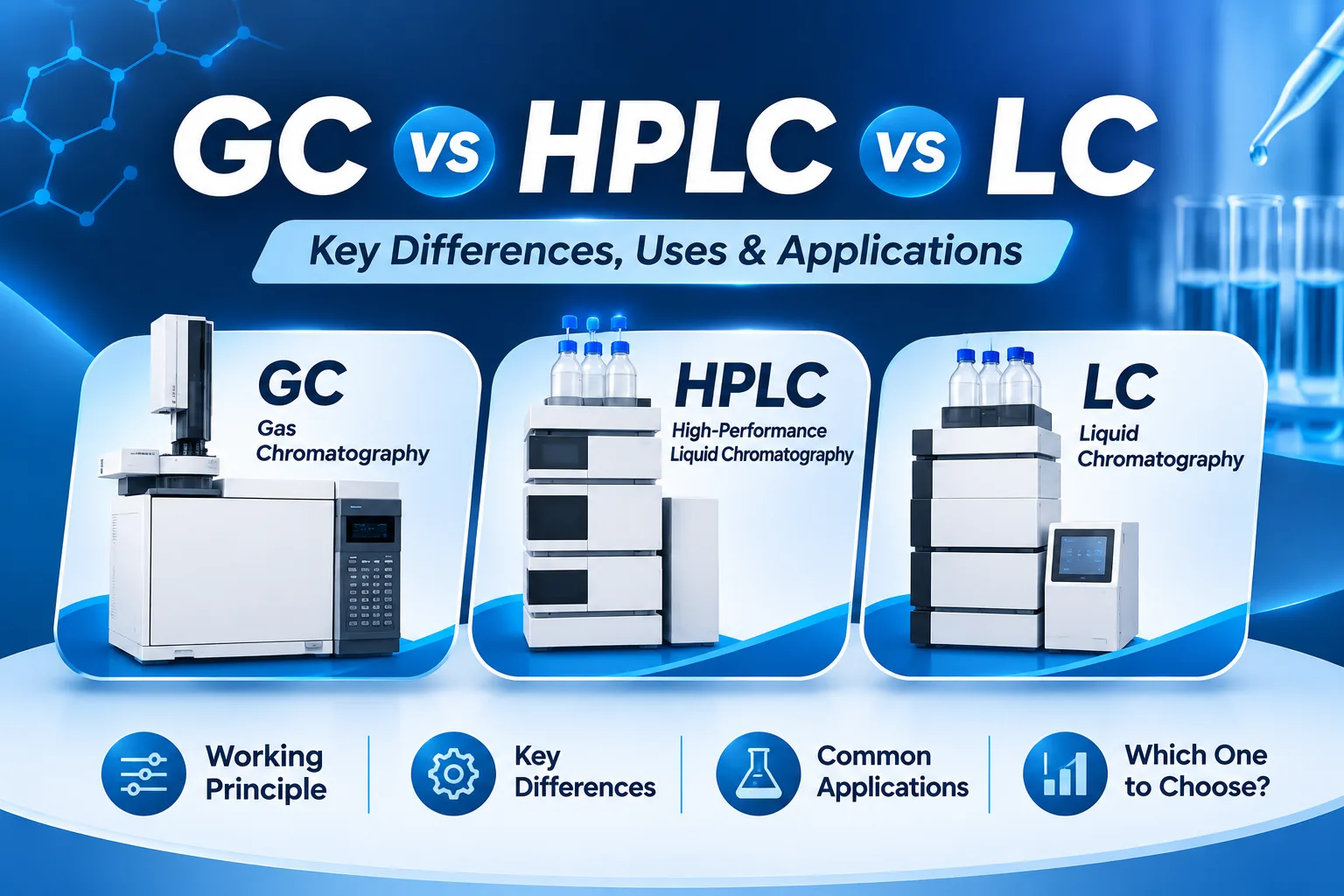
If you are setting up or upgrading a lab, the question of gas chromatography vs liquid chromatography usually comes up early. Both techniques separate a mixture into its individual components so you can identify and measure them, but they work in very different ways. Choosing the wrong one can mean failed methods, damaged samples or an instrument that sits unused.
The short answer is simple. Gas chromatography (GC) suits compounds that can be vaporized without breaking down. High performance liquid chromatography (HPLC) suits compounds that dissolve in a liquid, including those that are too fragile or too large to survive heat. This guide explains the difference between HPLC and GC in practical terms, shows where each one is used, helps you decide between them, and then covers GC-MS vs LC-MS for labs that need mass spectrometry.
Quick Answer: GC vs HPLC at a Glance
Gas chromatography moves a vaporized sample through a column using an inert carrier gas. HPLC pushes a liquid sample through a column using a pressurized liquid solvent. The nature of your sample decides which one fits.
|
|
Gas chromatography (GC) |
HPLC |
|---|---|---|
|
Mobile phase |
Inert gas such as helium or nitrogen |
Liquid solvent mixture |
|
Best suited for |
Volatile, thermally stable compounds |
Non-volatile, heat-sensitive or large molecules |
|
Sample state |
Vaporized in a heated inlet |
Dissolved in a liquid |
|
Common detectors |
FID, TCD, ECD, mass spectrometer |
UV or PDA, fluorescence, RI, mass spectrometer |
|
Typical uses |
Solvents, fuels, flavors, environmental volatiles |
Drugs, proteins, vitamins, dyes, preservatives |
What Is Gas Chromatography?
In gas chromatography, a small sample is injected into a heated inlet where it turns into vapor. An inert carrier gas sweeps that vapor onto a long, thin column housed in an oven. Compounds in the mixture interact differently with the coating inside the column, so they travel at different speeds and reach the detector at different times. The result is a chromatogram with one peak for each component.
Because the sample must be vaporized, GC works best for compounds that are volatile and stable at high temperatures. If you are weighing up equipment for this kind of work, our range of refurbished gas chromatography systems covers GC, GC-MS and headspace configurations.
What Is Liquid Chromatography and HPLC?
Liquid chromatography separates compounds that are dissolved in a liquid. In HPLC, a pump forces the liquid mobile phase through a column packed with fine particles at high pressure. Different compounds spend different amounts of time sticking to the packing material, so they exit the column at different times and are picked up by the detector.
Since nothing has to be vaporized, HPLC can handle compounds that would decompose in a GC oven, such as many pharmaceuticals, peptides, sugars and natural pigments. You can browse our refurbished HPLC systems from Waters, Agilent, Shimadzu and Perkin Elmer if you are comparing options.
Gas Chromatography vs HPLC: Key Differences
The table below summarizes the main differences. The sections after it explain the ones that matter most when you are choosing an instrument.
|
Parameter |
GC |
HPLC |
|---|---|---|
|
Mobile phase |
Carrier gas |
Liquid solvents |
|
Sample requirement |
Must vaporize without decomposing |
Must dissolve in the mobile phase |
|
Operating conditions |
Heated oven and inlet |
Usually near room temperature, high pressure |
|
Sample preparation |
Sometimes needs derivatization for polar compounds |
Often filtering and dissolving |
|
Running costs |
Carrier and detector gases |
Solvents, columns and waste disposal |
|
Typical sample size |
Very small injections |
Small injections, slightly larger volumes |
Mobile phase and separation
In GC the carrier gas does not interact with the sample. It simply carries the vapor along, so the separation depends mainly on the column coating and the oven temperature. In HPLC the liquid mobile phase is an active part of the separation. Changing the solvent mix, pH or gradient changes how compounds behave, which gives you a lot of flexibility when developing a method.
Sample type and volatility
This is the deciding factor in most cases. If your compounds evaporate cleanly and survive heat, GC is usually faster and simpler. If they are salts, large biomolecules or break down when heated, HPLC is the safer route. Some polar compounds can be chemically modified so that they work in GC, but that adds a step and another source of error.
Detectors, sensitivity and speed
GC commonly uses flame ionization detectors for hydrocarbons, thermal conductivity detectors for gases and electron capture detectors for halogenated compounds. HPLC most often uses UV or photodiode array detectors, with fluorescence and refractive index detectors for specific applications. Speed depends on the method, but if you want faster HPLC runs it is worth reading our comparison of HPLC and UPLC.
Gas vs Liquid Chromatography: How the Separation Works
Both techniques rely on the same basic idea. A mobile phase carries the sample past a stationary phase, and compounds that interact more strongly with the stationary phase move more slowly. What changes is the mobile phase. In gas chromatography it is a gas, which makes the process fast and efficient for small, volatile molecules. In liquid chromatography it is a liquid, which makes it possible to tune the separation through solvent chemistry and to analyze a much wider range of molecules.
This is why the two techniques are complementary rather than competing. Many labs run both because their sample portfolio covers volatile and non-volatile compounds.
HPLC and GC Analysis: Where Each Technique Is Used
Pharmaceuticals. HPLC is the standard for assay, impurity profiling and dissolution work, because most active ingredients are non-volatile. It is also central to shelf-life studies, which we cover in our guide to HPLC in pharmaceutical stability testing.
Quality control. GC is widely used for residual solvents, volatile impurities and raw material checks. If you run a regulated lab, our article on gas liquid chromatography in pharma QC shows how this looks in practice.
Research and development. R&D labs often need both, with GC for volatile profiling and HPLC for non-volatile characterization. Our piece on gas liquid chromatography in R&D labs covers how teams set up their GC work.
Food, beverage and environmental testing. GC is used for flavor compounds, pesticide residues and volatile organic compounds in air or water. HPLC is used for vitamins, preservatives, sweeteners, mycotoxins and dyes.
Petrochemicals. GC dominates here, since fuels and solvents are mixtures of volatile hydrocarbons.
When to Use GC vs HPLC
Use these questions as a starting point.
Choose GC when:
- Your compounds are volatile or can be vaporized without breaking down.
- You are analyzing small molecules such as solvents, gases, fuels or flavor compounds.
- You need a fast, high-resolution separation of a complex volatile mixture.
Choose HPLC when:
- Your compounds are heat-sensitive, non-volatile, ionic or have a high molecular weight.
- You are working with drugs, biomolecules, dyes or food additives.
- You want flexibility to adjust the separation by changing the mobile phase.
If your lab handles both kinds of samples, running GC and HPLC side by side is common and usually the most practical setup.
GC-MS vs LC-MS: Which Mass Spectrometry Technique Do You Need?
Both GC-MS and LC-MS pair a separation technique with a mass spectrometer, which identifies compounds by their mass. The choice follows the same logic as GC vs HPLC. GC-MS is the right tool for volatile and semi-volatile compounds. It is well established for identifying unknowns because the ionization method produces consistent fragmentation patterns that can be matched against reference libraries. LC-MS is the better choice for polar, thermally unstable or large molecules, including many drug metabolites and biomolecules, and it needs no vaporization step.
If you want some background on how LC-MS technology developed, our article on the evolution of LC-MS is a good read.
For labs that need identification power on volatile samples, a refurbished Perkin Elmer GC-MS system is a practical way to add mass spectrometry without a new-instrument budget.
Gas chromatography vs mass spectrometry: what is the difference?
These are not competing techniques, which is a common point of confusion. Gas chromatography separates the compounds in a mixture, and mass spectrometry identifies them. In a GC-MS system the GC does the separating and the mass spectrometer acts as the detector.
Buying Considerations: New vs Refurbished
Once you know which technique fits, the next question is usually budget. A refurbished GC or HPLC system can deliver the same analytical performance as a new one at a lower cost, provided it has been properly inspected, serviced and tested. When comparing options, ask about the instrument's service history, what was replaced during refurbishment, how it is tested before dispatch, and what support is available after installation.
If you want a single place to compare both techniques, see our refurbished GC and HPLC devices. If you are leaning towards liquid chromatography, our guide to buying refurbished HPLC in India walks through what to check before you commit.
Frequently Asked Questions
What is the main difference between gas and liquid chromatography?
The main difference is the mobile phase. Gas chromatography uses an inert gas to carry vaporized samples through a column, while liquid chromatography uses a liquid solvent to carry dissolved samples. This is why GC suits volatile compounds and HPLC suits non-volatile or heat-sensitive ones.
Is HPLC better than GC?
Neither is better in general. HPLC covers a wider range of compounds, including most drugs and biomolecules, while GC is often faster and simpler for volatile compounds. The better choice depends entirely on your sample.
Can GC and HPLC analyze the same sample?
Sometimes. Compounds that are both volatile and soluble can be analyzed by either technique. In practice, the choice then comes down to sensitivity needs, sample preparation effort and the equipment you have available.
Which technique has lower running costs?
It depends on the lab. GC mainly consumes gases, while HPLC consumes solvents and generates liquid waste that needs proper disposal. Column life and maintenance also affect the total cost for both.
Should I choose GC-MS or LC-MS?
Choose GC-MS if your target compounds are volatile and thermally stable. Choose LC-MS if they are polar, large or heat-sensitive. If you need both, many labs run the two systems in parallel.
Is a refurbished GC or HPLC reliable for routine QC work?
Yes, when it has been inspected, serviced and tested by an experienced supplier and comes with documented support. Always ask for the service history before buying.
Conclusion
The choice between gas chromatography vs liquid chromatography comes down to your sample. Volatile and thermally stable compounds point to GC, while non-volatile, heat-sensitive or large molecules point to HPLC. When you need identification as well as separation, the same logic applies to GC-MS and LC-MS. Many labs end up using both, because their work spans both kinds of samples.
If you are planning a new setup or an upgrade and want help matching an instrument to your applications, request a quote and our team will get back to you.
Related Posts
Waters Alliance 2695 HPLC System: Features, 2695 vs e2695 and How to Buy Refurbished
Learn what the Waters Alliance 2695 HPLC system does, how it differs from the e2695, and what to check before buying a refurbished unit.
What Is Gas Liquid Chromatography (GLC)? Meaning, Full Form, Principle, Types & How It Works
Learn what gas liquid chromatography (GLC) is, its full form, principle, types, working steps and applications, explained simply with a quick answer for each.
Gas Liquid Chromatography: Components, Diagram, Columns, Carrier Gas & Mobile Phase
See a gas liquid chromatography diagram and learn its components, column types, carrier gases, mobile phase, GC conditions and method in simple steps.