Waters Alliance 2695 HPLC System: Features, 2695 vs e2695 and How to Buy Refurbished
Nov 8, 2026
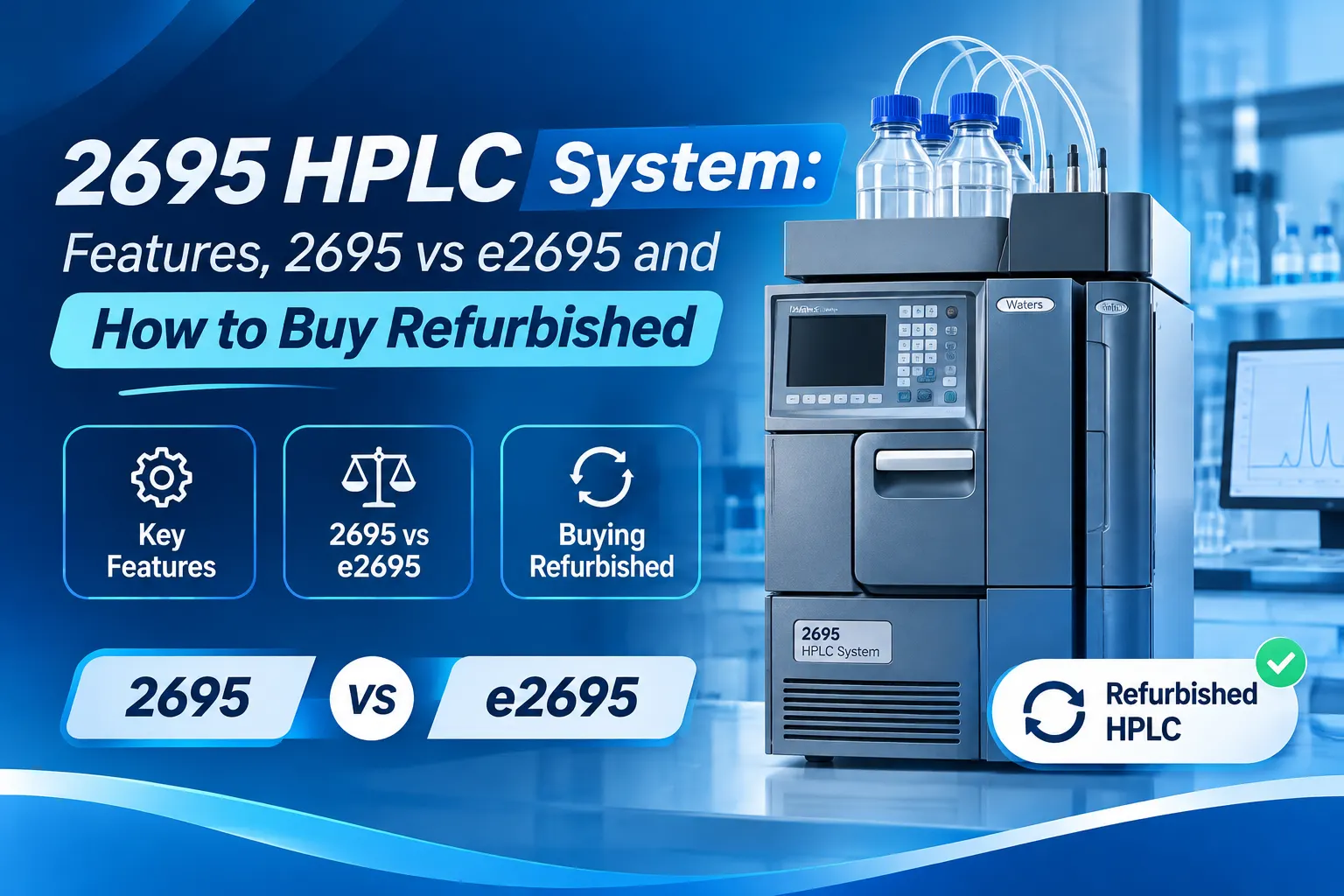
The Waters Alliance 2695 is one of the most widely installed HPLC platforms in quality control and research labs, which is why so many buyers look for it on the refurbished market. It is also easy to misunderstand. The 2695 is a separations module, not a complete system, and the newer e2695 is often described as a different model when the real difference is smaller than most listings suggest.
This guide answers the questions buyers ask most often: what the 2695 is, what it can do, how it differs from the e2695, and what to check before you buy a refurbished unit. Specifications come from Waters documentation, and the sources are listed at the end.
What is the Waters Alliance 2695 HPLC system?
The Alliance 2695 is an integrated separations module. Waters describes the related e2695 as a module with integrated solvent and sample management, which means the pump, solvent degassing, autosampler and optional column heater sit in one unit. You then add a detector to make a working Waters Alliance HPLC system.
The module can mix one to four solvents, which makes it suitable for both isocratic and gradient methods. It holds 120 sample vials in five carousels of 24, and it is typically paired with Waters detectors such as PDA, UV/Vis, refractive index or fluorescence. It is controlled by Empower or MassLynx software.
If you are comparing an Alliance with a modular system where each component is a separate box, the main practical difference is footprint and integration. In the Alliance, the solvent delivery and sample management are designed to work as one unit.
What are the key specifications of the Waters 2695 separations module?
The figures below come from the Waters e2695 instrument specification sheet (720004547EN). Waters' own knowledge base answers many specification questions for the 2690, 2695 and e2695 together, and it gives the same injection volume range for the 2695 and e2695.
|
Parameter |
Waters specification |
|---|---|
|
Number of solvents |
One to four, with vacuum degassing |
|
Flow rate range |
0.01 to 10.000 mL/min (0.05 to 5.000 mL/min typical) |
|
Maximum operating pressure |
5,000 psi (345 bar) at 0.010 to 3.000 mL/min |
|
Dwell volume (total system) |
1.145 mL or less |
|
Gradient profiles |
11 curves, including linear, step, concave and convex |
|
Flow accuracy |
±1% or 10 µL/min, whichever is greater (0.200 to 5.000 mL/min) |
|
Injection volume |
0.1 to 100 µL standard; up to 2,000 µL with an optional loop |
|
Sample capacity |
120 vials (five carousels of 24) |
|
Sample carryover |
0.0025% or less for caffeine, under specified conditions |
|
Sample temperature control (optional) |
About 4 °C to 40 °C |
|
Column heater (optional) |
20 to 65 °C |
|
Communications |
IEEE-488, RS-232, Ethernet |
|
Software control |
Empower or MassLynx |
These values describe a new instrument under Waters test conditions. A refurbished unit should be tested against the same criteria, and the section on buying below explains which ones matter most.
What is the difference between the Waters 2695 and the e2695?
The main difference is how the module communicates with the computer. The 2695 uses IEEE-488 communication. The e2695 adds built-in Ethernet (LAN) communication. Waters distributors describe the e2695 as an update of the 2695 with the same separation performance, so methods transfer between the two without redevelopment.
|
|
Alliance 2695 |
Alliance e2695 |
|---|---|---|
|
Computer communication |
IEEE-488 |
Ethernet, and on units made before 2025 also IEEE-488 |
|
Separation performance |
Same platform |
Same platform |
|
Firmware updates |
Not eligible for the e2695 firmware unless upgraded to Ethernet |
Supported, including firmware 3.06 |
|
Empower connection |
Via IEEE-488 card |
Via Ethernet or IEEE-488 (not both at once) |
There are three practical points to take from Waters' knowledge base:
- Ethernet upgrades for older 2695 units are no longer available. Waters states that IEEE systems are not eligible for the update path because the Ethernet upgrades were discontinued. Firmware 3.06 can be installed only on an e2695 or a 2695 that was previously upgraded to Ethernet.
- The newest e2695 units are Ethernet only. Waters says units produced in 2025 and later have no IEEE board.
- MassLynx limits apply. MassLynx cannot control an e2695 over Ethernet, so a lab that runs MassLynx needs an IEEE-capable unit.
In short, the right choice depends on your software and your computer. If your lab runs Empower 3 on a modern network setup, an e2695 or an Ethernet-upgraded 2695 is the easier fit. If you already run IEEE-488 and want a lower cost, a 2695 can work well.
Is the Waters Alliance 2695 suitable for my method?
It suits most routine HPLC methods, including assay, impurity testing, dissolution samples and content uniformity in pharma QC, as well as food and environmental testing. Gradient methods work well because of the four-solvent proportioning and low dwell volume.
The main limit is pressure. The module is specified to 5,000 psi, which is appropriate for conventional HPLC columns. Methods built for sub-2 µm particles typically need a higher-pressure UHPLC system, so a method written for that kind of column may not transfer directly. Our comparison of HPLC and UPLC explains how to tell which type of system your method needs.
Which detectors and software work with the Alliance 2695?
The separations module does not include a detector, so you choose one to suit your method. Waters detectors commonly used with Alliance systems include the 2998 PDA, 2489 UV/Vis, 2414 refractive index and 2475 fluorescence detectors.
For software, Waters lists Empower and MassLynx as the supported control options. Confirm which software version your lab uses before you buy, because the communication type of the module (IEEE or Ethernet) decides which setups are possible.
Is it a good idea to buy a refurbished Waters Alliance 2695?
For many labs, yes. The platform is well established, methods are widely validated on it, and a refurbished unit costs less than a new instrument. Waters also continues to list service parts and a performance maintenance kit for the 2690, 2695 and e2695, which helps with long-term upkeep.
The trade-offs are the same as for any refurbished system. A refurbished unit usually does not carry an OEM warranty, so the quality of the supplier's inspection and the support after sale matter more than the age of the instrument.
What should I check before buying a refurbished Waters 2695?
Start with the configuration, then ask for evidence that the unit meets Waters' own performance criteria.
|
Check |
What to ask for |
Why it matters |
|---|---|---|
|
Module model and communication |
Whether it is a 2695 or e2695, and whether it uses IEEE or Ethernet |
Decides which software and computer setups will work |
|
Configuration |
Whether the detector, column heater and sample heater/cooler are included |
Methods often depend on temperature control |
|
Pump pressure ripple |
Waters lists 2.5% or less at 1 mL/min, degassed methanol, 1,700 psi back pressure |
A stable baseline and reliable retention times |
|
Flow accuracy |
Waters lists ±1% or 10 µL/min, whichever is greater |
Affects retention time reproducibility |
|
Dwell volume |
Waters lists 1.145 mL or less |
Matters when transferring gradient methods |
|
Injection performance |
Injection accuracy, precision and carryover results |
Affects quantitative results |
|
Wear parts |
When seals, check valves and the injector parts were last replaced |
The most common maintenance items |
|
Firmware and software |
Firmware version and the Empower or MassLynx version supported |
Avoids compatibility problems after installation |
|
Documentation |
A test report and the operator's guide |
Needed for qualification in regulated labs |
If you work in a regulated lab, also ask about installation and operational qualification support. Our wider guide to buying a refurbished HPLC covers supplier checks that apply to any brand.
Does Spectrachrome supply a refurbished Waters Alliance 2695?
Yes. Spectrachrome lists a refurbished Waters 2695 Alliance HPLC system, supplied as an integrated separations module with a separate detector. Configurations differ from unit to unit, so the quotation confirms the exact module, detector and accessories you will receive. If you want to compare it with other brands and models, you can browse the full Waters range.
Where can I find the Waters 2695 operator's guide?
Waters publishes the operator's guides on its website. From the Alliance HPLC System page, select Support, then User Manuals, and choose the 2695 or e2695 Separations Module Operator's Guide. Use it to confirm specifications and maintenance steps for the exact model you are considering.
Frequently asked questions
Is the Waters Alliance 2695 a complete HPLC system?
No. It is the separations module, which includes the pump, degasser and autosampler. You add a detector, and optionally a column heater, to build a working system.
Is the e2695 faster or more accurate than the 2695?
Waters distributors describe the two as having the same performance, and Waters' knowledge base gives the same injection volume range for both. The main difference is Ethernet communication on the e2695.
Can I upgrade a 2695 to an e2695?
Waters states that its Ethernet upgrades have been discontinued, so you should not assume an older 2695 can be upgraded. Confirm the module's communication type before you buy.
Which software controls a Waters Alliance HPLC system?
Waters lists Empower and MassLynx. Check which version your lab uses, because MassLynx cannot control an e2695 over Ethernet.
How often does a 2695 need maintenance?
Follow the operator's guide and your lab's SOP. Waters offers a performance maintenance kit for the 2690, 2695 and e2695, which covers the common wear parts.
Conclusion
The Waters Alliance 2695 remains a dependable choice for routine HPLC work, and the e2695 is essentially the same platform with Ethernet communication. The real decision comes down to your software, your computer setup and the condition of the specific unit you are buying. Ask for the configuration, the communication type and test results against Waters' specifications before you commit.
If you are planning to add a Waters Alliance HPLC system to your lab, request a quote with your method details and we will confirm availability and configuration.
Related Posts
GC vs HPLC vs LC: Difference Between Gas and Liquid Chromatography
Gas chromatography vs liquid chromatography explained. See the key differences between GC and HPLC, a comparison table and GC-MS vs LC-MS.
What Is Gas Liquid Chromatography (GLC)? Meaning, Full Form, Principle, Types & How It Works
Learn what gas liquid chromatography (GLC) is, its full form, principle, types, working steps and applications, explained simply with a quick answer for each.
Gas Liquid Chromatography: Components, Diagram, Columns, Carrier Gas & Mobile Phase
See a gas liquid chromatography diagram and learn its components, column types, carrier gases, mobile phase, GC conditions and method in simple steps.