What Is Gas Liquid Chromatography (GLC)? Meaning, Full Form, Principle, Types & How It Works
Nov 3, 2026
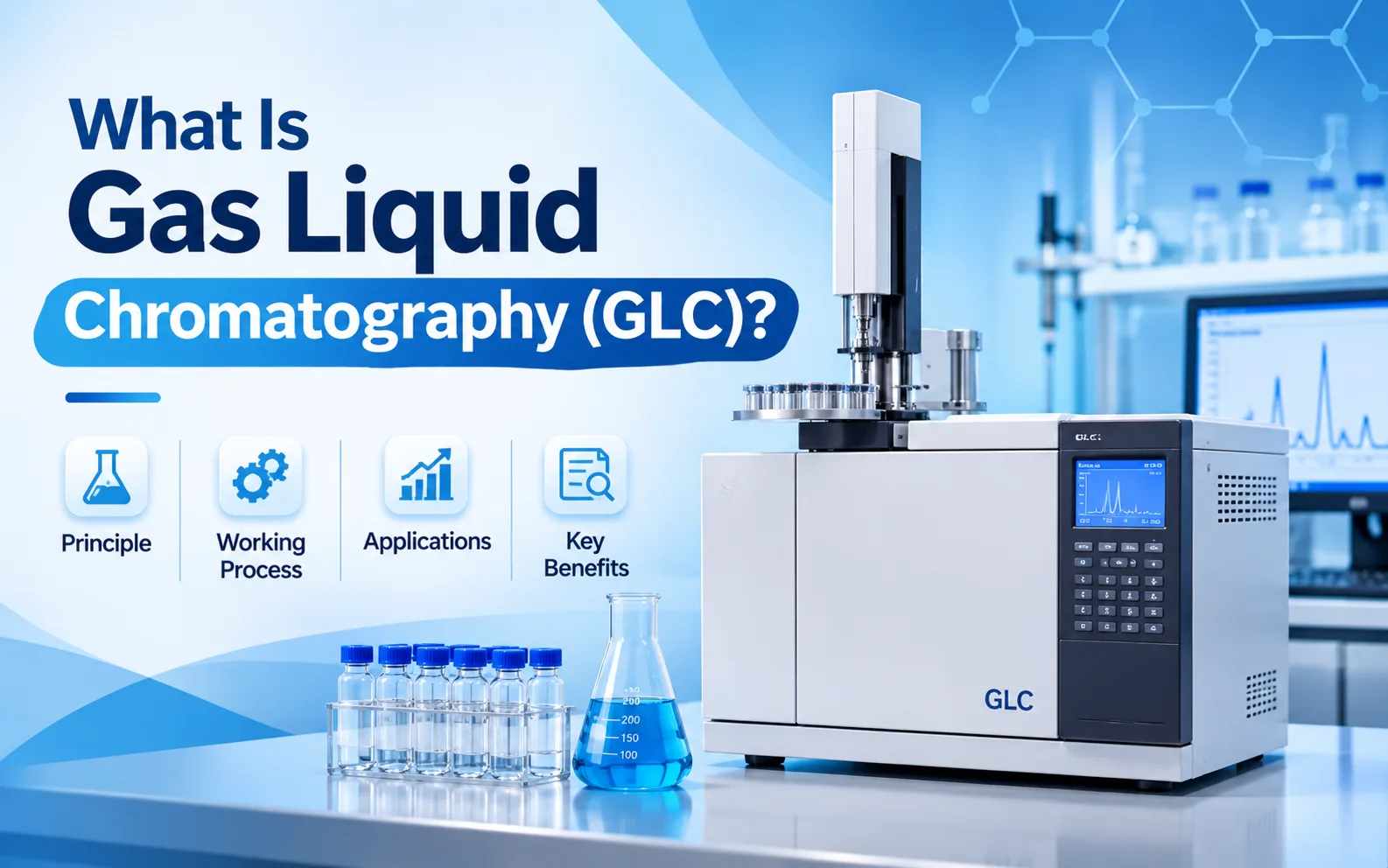
What Is Gas Liquid Chromatography?
Gas liquid chromatography (GLC) is a separation technique in which a vaporised sample is carried by an inert gas through a column coated with a liquid, so that each component of the mixture travels at a different speed and separates from the others.
In simple words, gas-liquid chromatography works like a race. A mixture is injected into a heated column, and its components compete to move through it. Compounds that dissolve less in the liquid coating run ahead; those that dissolve more lag behind. Scientists then detect each compound as it leaves the column. This is why gas chromatography explained in simple terms often uses the idea of a "race through a coated tube".
What Is the Full Form of GLC?
The GLC full form is Gas-Liquid Chromatography. The "gas" is the mobile phase (carrier gas) and the "liquid" is the stationary phase coated on a solid support or on the inner wall of the column.
You may also see it written as gas liquid chromatography GLC or simply GLC chromatography. All of these mean the same technique.
What Is GC and What Is the Full Form of GC?
GC stands for gas chromatography. So when people ask what is GC or what is GC chromatography, the answer is: a laboratory technique that separates and analyses compounds that can be vaporised without breaking down. The full form of GC is Gas Chromatography, and what is G C is just another way people type the same query. Terms like chromatography GC, chromatography gas and gas phase chromatography all refer to this family of methods.
What Is the Meaning of Gas Chromatography?
The gas chromatography meaning is simple: it is a method to define gas chromatography as a process of separating the components of a volatile mixture between a moving gas phase and a stationary phase. It is used to identify what a sample contains and how much of each substance is present.
What Is the Principle of Gas Liquid Chromatography?
The principle of gas liquid chromatography is partition: components separate because they distribute differently between the moving carrier gas and the stationary liquid phase based on their solubility and boiling point.
The principle of GLC can be understood in three points:
- A compound that dissolves well in the liquid phase spends more time in the column and exits later.
- A compound that dissolves poorly spends more time in the gas phase and exits earlier.
- The time a compound takes to exit is called its retention time, and it helps identify that compound.
This is also the working principle of gas chromatography in its most common form.
How Does Gas Liquid Chromatography Work?
How does gas liquid chromatography work? A sample is injected and vaporised, carried by an inert gas through a temperature-controlled column, separated by partitioning, and then detected as peaks on a chromatogram.
Here is how gas liquid chromatography works step by step:
- Injection: A tiny liquid or gas sample is injected into a hot injection port, where it vaporises instantly.
- Carrier gas flow: An inert gas such as helium, nitrogen or hydrogen pushes the vapour into the column.
- Separation: Inside the column, each component partitions between the gas and the liquid coating at its own rate.
- Detection: As each component exits, a detector produces an electrical signal.
- Recording: The signal is plotted as a chromatogram, where each peak represents one compound and its area shows the quantity.
This is also the answer to how does a gas chromatography work and how do gas chromatography work for beginners.
How Does GC Separate Compounds?
How does GC separate compounds? It separates them by differences in boiling point and in how strongly each compound interacts with the stationary phase inside the column.
When you ask how does a gas chromatography separate compounds, the key idea is that no two compounds behave identically. Smaller, more volatile molecules usually travel faster. Compounds with similar boiling points can still be separated if the stationary phase interacts with them differently. Raising the oven temperature gradually, called temperature programming, helps separate complex mixtures in a shorter time.
What Are the Main Components of a Gas Liquid Chromatography Instrument?
A GLC instrument has six main parts: a carrier gas supply, an injector, a column, a column oven, a detector and a data system.
- Carrier gas: An inert, high-purity gas (helium, nitrogen or hydrogen) that moves the sample along.
- Injector: Vaporises the sample and introduces it into the column.
- Column: The heart of the system, where separation happens. It holds the liquid stationary phase.
- Oven: Controls the column temperature precisely.
- Detector: Senses compounds leaving the column. Common types are the flame ionisation detector (FID), thermal conductivity detector (TCD), electron capture detector (ECD) and the mass spectrometer (MS) used in a GC-MS system.
- Data system: Converts detector signals into a readable chromatogram.
What Are the Types of Gas Chromatography?
There are two main types of gas chromatography: gas-solid chromatography (GSC) and gas-liquid chromatography (GLC), classified by the kind of stationary phase used.
If you are searching for types of GC, here is the full picture:
- Gas-Solid Chromatography (GSC): The stationary phase is a solid adsorbent such as silica or molecular sieves. Separation happens by adsorption. It suits permanent gases and light hydrocarbons.
- Gas-Liquid Chromatography (GLC): The stationary phase is a liquid coated on a support. Separation happens by partition. It is the most widely used type.
Based on column design, GC is also divided into:
- Packed column GC: A tube filled with coated solid support. Simple and high in sample capacity.
- Capillary column GC: A very narrow hollow tube with the liquid phase coated on its wall. It gives sharper peaks and better resolution.
What Is the Difference Between Gas Chromatography and Gas Liquid Chromatography?
The difference between gas chromatography and gas liquid chromatography is that gas chromatography is the broad technique, while GLC is one specific type that uses a liquid stationary phase.
In short, every GLC is a form of GC, but not every GC is GLC, because GC also includes gas-solid chromatography. In everyday lab language, people often use "GC" and "GLC" interchangeably because GLC is by far the most common form.
What Are the Applications of Gas Liquid Chromatography?
GLC is used wherever volatile compounds need to be separated, identified or measured, including pharmaceuticals, food, environmental testing, forensics and petrochemicals.
- Pharmaceuticals: Purity testing and residual solvent analysis in drugs.
- Environmental testing: Detecting pesticides, pollutants and VOCs in air and water, often with headspace GC.
- Food and beverage: Analysing flavours, fragrances, fatty acids and contaminants.
- Forensics: Testing blood alcohol, drugs and fire accelerants.
- Petrochemicals: Analysing fuels, oils and hydrocarbon mixtures.
- Clinical research: Studying metabolites and breath components in R&D labs.
What Are the Advantages and Limitations of GLC?
GLC is fast, sensitive and highly accurate, but it works only for samples that are volatile and thermally stable.
Advantages:
- High resolution and excellent sensitivity, even for trace amounts.
- Quick analysis, often within minutes.
- Needs only a very small sample.
- Gives both qualitative and quantitative results.
Limitations:
- Cannot analyse non-volatile or heat-sensitive compounds without special preparation; HPLC is the usual alternative.
- Instruments and columns can be costly, which is why many labs choose refurbished systems.
- Requires skilled operation and regular maintenance.
Final Thoughts
Gas liquid chromatography remains one of the most reliable tools for separating and measuring volatile compounds. Once you understand the GLC full form, the principle of GLC, and how the carrier gas, column and detector work together, the technique becomes easy to follow. Whether you are a student revising for an exam or a professional choosing an analytical method, knowing the types of gas chromatography and the difference between gas chromatography and gas liquid chromatography will help you apply it correctly.
Where Can You Buy a Gas Chromatography System in India?
Spectrachrome India supplies refurbished gas chromatography systems for pharma, research and testing labs across the country.
A popular starting point is the Perkin Elmer Clarus gas chromatography system.
Not sure which model fits your lab? Request a quote and the team will help you choose.
Related Posts
Gas Liquid Chromatography: Components, Diagram, Columns, Carrier Gas & Mobile Phase
See a gas liquid chromatography diagram and learn its components, column types, carrier gases, mobile phase, GC conditions and method in simple steps.
Refurbished UV-Vis Spectrophotometer in India: Performance Checks to Run Before You Buy
Buying a refurbished UV-Vis spectrophotometer in India? Run 6 checks: wavelength, photometric accuracy, stray light, lamp hours, warranty.
Clinical LC-MS/MS in India: Steroid Panels, Drug Monitoring, Vitamin D and Newborn Screening on a Refurbished Triple Quadrupole
A practical guide for lab owners, clinicians and MSc scholars on moving steroid panels, drug monitoring, vitamin D and newborn screening to LC-MS/MS. It covers method validation, NABL accreditation and a 10-point checklist for buying a certified refurbished triple quadrupole