HPLC vs UPLC: Which Chromatography System Does Your Lab Actually Need?
Sep 2, 2026
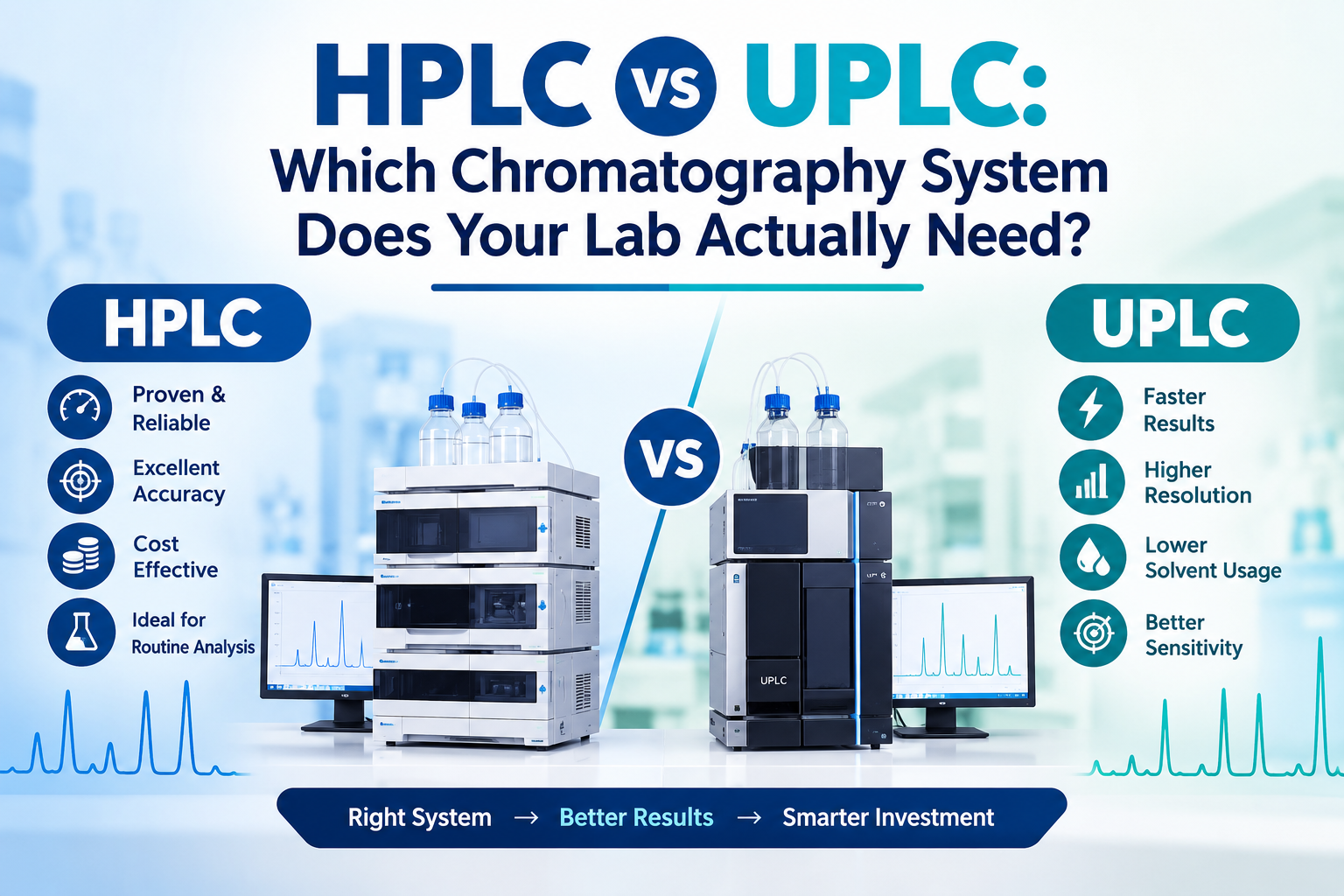
In the highly competitive and rigorously regulated world of analytical chemistry, the choice of liquid chromatography instrumentation is one of the most critical decisions a laboratory manager or principal investigator must make. For decades, High-Performance Liquid Chromatography (HPLC) has been the undisputed backbone of analytical testing across industries ranging from pharmaceuticals to environmental science. It has provided the reliability, robustness, and reproducible data necessary to ensure drug safety, environmental compliance, and product quality. However, the introduction of Ultra-Performance Liquid Chromatography (UPLC) shifted the paradigm, offering unprecedented speed, superior resolution, and enhanced sensitivity.
The debate surrounding the "HPLC vs UPLC comparison" is not merely about technical specifications; it is about balancing analytical requirements with economic realities. In research institutions and quality control laboratories across India and the globe, the pressure to increase sample throughput while simultaneously reducing operational costs is immense. UPLC systems promise significant time and solvent savings, but they come with a substantially higher initial capital investment, more demanding maintenance protocols, and stricter requirements for sample preparation. Conversely, HPLC systems are universally understood, incredibly robust, and highly cost-effective, particularly when handling routine analyses or challenging sample matrices.
Choosing between HPLC and UPLC requires a nuanced understanding of your laboratory's specific analytical goals, workflow demands, and budget constraints. A pharmaceutical contract research organization (CRO) analyzing hundreds of complex biological samples daily may find the high throughput of UPLC indispensable. In contrast, a routine quality assurance lab monitoring bulk drug formulations might find that a high-quality HPLC system meets all regulatory requirements without the need for extreme pressures or sub-2-micron columns.
This comprehensive guide delves deep into the technological distinctions, operational nuances, and financial implications of HPLC and UPLC. By dissecting the working principles, exploring core applications, and analyzing real-world research, we aim to provide you with the definitive insights needed to determine which chromatography system your lab actually needs to thrive in today's demanding scientific landscape.
Working Principle: How Liquid Chromatography Works
To fully appreciate the differences between HPLC and UPLC, one must first understand the fundamental principles that govern liquid chromatography. Both techniques rely on the separation of a mixture into its individual components based on their differential interactions between a stationary phase (the column packing material) and a mobile phase (the solvent carrying the sample).
The sample is injected into a continuously flowing stream of the mobile phase, which is pumped under high pressure through a column packed with the stationary phase. As the sample mixture travels through the column, different analytes interact with the stationary phase to varying degrees. Molecules that have a stronger affinity for the stationary phase are retained longer and elute (exit the column) later, while those with a weaker affinity elute earlier. This differential retention results in the separation of the mixture, allowing a detector at the end of the column to measure the concentration of each eluted component, generating a chromatogram.
The fundamental difference between HPLC and UPLC lies primarily in the particle size of the stationary phase and the corresponding pressure required to drive the mobile phase through the column. This relationship is elegantly described by the Van Deemter equation, a cornerstone of chromatographic theory. The equation models the relationship between the linear velocity of the mobile phase and the plate height (a measure of column efficiency). According to the Van Deemter plot, smaller particle sizes not only reduce the plate height (thereby increasing resolution and efficiency) but also flatten the curve at higher mobile phase velocities. This means that with smaller particles, you can run the mobile phase much faster without sacrificing resolution—a theoretical foundation that UPLC brilliantly exploits.
However, utilizing smaller particles (sub-2 micron in UPLC compared to 3-5 micron in traditional HPLC) creates significant backpressure. While conventional HPLC systems operate at maximum pressures around 400 to 600 bar (approx. 6,000 to 9,000 psi), UPLC systems are engineered to withstand extreme pressures up to 1,000 to 1,500 bar (approx. 15,000 to 22,000 psi) to overcome this resistance and achieve ultra-fast separations.
Key Components
Both HPLC and UPLC systems share the same basic architectural components, although UPLC parts are engineered to withstand significantly higher pressures and minimize system volume.
· Solvent Delivery System (Pumps): The heart of the system. HPLC pumps provide a steady, pulse-free flow at up to 600 bar. UPLC pumps must deliver ultra-precise gradients at pressures exceeding 1000 bar without fluctuations that could affect retention times.
· Sample Injector (Autosampler): Introduces the sample into the pressurized mobile phase stream. UPLC autosamplers must execute extremely fast injection cycles with minimal sample dispersion (extra-column volume) to maintain sharp peaks.
· Chromatographic Column: The site of separation. HPLC columns typically contain silica-based particles ranging from 3 to 5 microns in diameter. UPLC columns are packed tightly with sub-2 micron particles (often 1.7 or 1.8 µm), requiring specialized hardware to contain them under extreme pressure.
· Detector: Identifies and quantifies the separated components as they elute. Detectors (UV-Vis, PDA, MS, etc.) in UPLC must have extremely fast sampling rates (data acquisition rates) and low-volume flow cells to capture the incredibly narrow, fast-eluting peaks without peak broadening.
· Data Management System: Advanced software that controls the instrument modules, acquires the high-speed data, and processes the complex chromatograms.
Core Applications: Where Are HPLC and UPLC Used?
Both HPLC and UPLC are indispensable across a multitude of scientific disciplines. While they can often perform the same types of analyses, UPLC is typically favored when speed, extreme resolution for complex mixtures, or ultra-trace sensitivity is paramount.
Application 1: Pharmaceutical Quality Control and R&D
In the pharmaceutical industry, liquid chromatography is ubiquitous. It is utilized throughout the drug development lifecycle, from early-stage discovery to post-market surveillance.
· HPLC Applications: Routine quality control (QC) testing of active pharmaceutical ingredients (APIs) and finished dosage forms heavily relies on HPLC. For established drugs, compendial methods (such as those in the USP or Indian Pharmacopoeia) are predominantly HPLC-based. Its robustness handles a wide variety of sample matrices with minimal downtime.
· UPLC Applications: UPLC excels in pharmaceutical R&D, particularly in forced degradation studies, impurity profiling, and the analysis of complex biologics (like monoclonal antibodies). The enhanced resolution of UPLC allows scientists to separate structurally similar impurities that might co-elute on a standard HPLC column. Furthermore, the speed of UPLC dramatically accelerates method development and validation processes, shortening the time-to-market for new therapeutics.
Application 2: Clinical Diagnostics and Bioanalysis
Analyzing biological fluids (blood, plasma, urine) requires high sensitivity and the ability to distinguish target analytes from endogenous interference.
· HPLC Applications: HPLC, often coupled with mass spectrometry (LC-MS) or electrochemical detection, is widely used for routine therapeutic drug monitoring and measuring specific biomarkers where the analysis time is not the primary bottleneck.
· UPLC Applications: In high-throughput clinical labs and pharmacokinetic (PK) studies, UPLC (specifically UPLC-MS/MS) is revolutionary. The sharp, narrow peaks produced by UPLC dramatically improve the signal-to-noise ratio, enhancing the sensitivity required to detect trace levels of drugs or metabolites in complex biological matrices. The rapid run times allow for the processing of hundreds of patient samples per day, which is critical in large-scale clinical trials.
Application 3: Environmental and Food Safety Monitoring
Monitoring our environment and food supply involves detecting trace contaminants, pesticides, and toxins in diverse and often difficult matrices.
· HPLC Applications: HPLC is standard for analyzing water and soil samples for known pollutants. It is widely used for determining preservatives, artificial colors, and vitamins in food products where standard regulatory methods prescribe its use.
· UPLC Applications: When screening for hundreds of pesticide residues in agricultural products or monitoring emerging contaminants in wastewater, UPLC is preferred. The superior resolving power allows for multi-residue methods that can separate and identify numerous contaminants in a single, fast run. The reduced solvent consumption of UPLC is also highly attractive for environmental labs looking to minimize their own chemical waste footprint.
Detailed Comparison: HPLC vs UPLC
To make an informed decision, laboratory professionals must critically evaluate the distinct differences between these two powerful technologies. Here is a detailed breakdown of the HPLC vs UPLC comparison.
Particle Size and Pressure Requirements
The most defining distinction is the stationary phase particle size. HPLC typically utilizes columns packed with 3 to 5-micron particles. These larger particles create moderate resistance to fluid flow, resulting in standard operating pressures of 400 to 600 bar.
UPLC utilizes sub-2-micron particles (e.g., 1.7 µm). According to chromatographic theory, decreasing particle size increases column efficiency and resolution. However, the resistance to flow increases inversely with the square of the particle diameter. Consequently, pushing solvent through these tightly packed columns requires specialized instrumentation capable of operating reliably at extreme pressures (1,000 to 1,500 bar). This necessitates ultra-robust pumps, specialized tubing, and high-pressure fittings, significantly increasing the complexity and cost of the UPLC hardware.
Speed and Resolution
This is where UPLC truly shines. Because the Van Deemter curve for sub-2-micron particles is relatively flat at high flow velocities, UPLC allows you to increase the flow rate dramatically without losing column efficiency (resolution).
· HPLC: A typical analytical run might take anywhere from 15 to 45 minutes, depending on the complexity of the gradient and the length of the column.
· UPLC: Can perform the same separation in 2 to 10 minutes. Furthermore, the smaller particles generate narrower, sharper peaks, resulting in vastly superior resolution. This is critical for separating complex mixtures or closely related structural isomers that would otherwise overlap on an HPLC system.
Sensitivity and Data Quality
The sharper, narrower peaks generated by UPLC have a direct impact on sensitivity. Because the analyte elutes in a smaller volume of mobile phase, its concentration at the detector is higher, resulting in a taller peak. This dramatically improves the signal-to-noise ratio.
For trace analysis, impurity profiling, and especially when coupled with Mass Spectrometry (UPLC-MS), UPLC provides significantly better sensitivity and data quality than standard HPLC. However, to capture these narrow peaks accurately, the detector must have a very fast data acquisition rate (sampling rate) and a minimal internal volume flow cell to prevent peak dispersion.
Running Costs and Solvent Consumption
· HPLC: Traditional systems consume significant volumes of high-purity solvents (often 1 to 2 mL/min over a 30-minute run). Solvent procurement and hazardous waste disposal constitute a major portion of a lab's operating budget.
· UPLC: Because UPLC columns are typically shorter and have narrower internal diameters, and the runs are much faster, solvent consumption is drastically reduced—often by up to 80%. Over time, this reduction in solvent purchasing and disposal costs can offset the higher initial purchase price of the UPLC system, presenting a compelling long-term economic argument for high-throughput labs.
Column Compatibility, Maintenance, and Usability
· HPLC: HPLC systems are renowned for their robustness. They are forgiving of slightly imperfect sample preparation. Columns are relatively inexpensive, widely available from countless vendors, and less prone to clogging. Maintenance is straightforward, and troubleshooting is a well-established skill among most analytical chemists.
· UPLC: UPLC requires meticulous sample preparation. Because the frits that retain the sub-2-micron particles have incredibly small pores, any particulate matter in the sample or mobile phase will quickly clog the system, leading to rapid pressure increases and column failure. UPLC columns are more expensive and often proprietary. The instrumentation itself, operating at extreme pressures, experiences greater wear and tear on pump seals and injection valves, demanding strict adherence to preventative maintenance schedules.
Research Spotlight: What Science Says
The transition from HPLC to UPLC and their comparative performance has been extensively documented in scientific literature. Here are key findings from notable research studies:
Featured Research Studies
1. Comparative Study on Pharmaceutical Impurity Profiling
· Authors: Novakova, L. et al.
· Institution: Charles University, Prague.
· Journal: Journal of Pharmaceutical and Biomedical Analysis (2006).
· Key Finding: The study demonstrated that transferring a compendial HPLC method for impurity profiling to a UPLC method resulted in a 6-fold reduction in analysis time (from 35 minutes to under 6 minutes) and an 85% reduction in solvent consumption, while significantly improving the resolution of closely eluting degradants.
· Relevance: Highlights the immense time and cost-saving potential of UPLC for routine pharmaceutical analysis.
2. Evaluation of Sub-2 µm Particles in Environmental Analysis
· Authors: Leandro, C.C. et al.
· Institution: University of Almería, Spain.
· Journal: Journal of Chromatography A (2006).
· Key Finding: Researchers compared conventional HPLC with UPLC for the multi-residue analysis of pesticides in food matrices. The UPLC system provided a 4-fold increase in sensitivity and allowed for the baseline separation of 25 pesticides in under 5 minutes, a task that required nearly 30 minutes on traditional HPLC.
· Relevance: Confirms the superior resolving power and sensitivity of UPLC for complex, multi-analyte environmental and food safety matrices.
3. Method Transfer Challenges: HPLC to UHPLC
· Authors: Guillarme, D. et al.
· Institution: University of Geneva, Switzerland.
· Journal: LC-GC Europe (2010).
· Key Finding: The authors extensively reviewed the theoretical and practical challenges of transferring established HPLC methods to UPLC platforms. They emphasized that while time and solvent savings are substantial, analysts must carefully manage extra-column band broadening, frictional heating inside the column, and detector sampling rates to realize the full benefits of sub-2-micron technology.
· Relevance: A critical reminder that UPLC requires a higher level of user expertise and optimized hardware configurations to prevent data quality degradation.
4. Economic Viability of UPLC in Routine Quality Control
· Authors: Swartz, M.E.
· Institution: Waters Corporation (Foundational Whitepaper).
· Journal: Separation Science (2005).
· Key Finding: An early but foundational analysis demonstrating that despite the higher initial capital expenditure, the dramatic reduction in run times (increased sample throughput) and solvent consumption yields a return on investment (ROI) within 6 to 12 months for high-volume laboratories compared to traditional HPLC systems.
·Relevance: Provides the economic justification often needed by lab managers to upgrade to UPLC technology.
How These Systems Help Your Lab
Integrating the right liquid chromatography system fundamentally dictates your laboratory's operational efficiency, data integrity, and bottom line.
For high-throughput environments—such as clinical trial support, large-scale environmental screening, or pharmaceutical R&D—the extreme speed of UPLC translates directly into dramatically increased productivity. A lab that previously processed 50 samples a day on an HPLC can potentially process 200 or more on a UPLC. This increased throughput reduces the cost per sample, accelerates project timelines, and enhances the lab's capacity to take on new business. Furthermore, the massive reduction in solvent consumption not only saves money but also aligns with corporate sustainability and green chemistry initiatives.
Conversely, for laboratories focused on routine quality assurance, manufacturing support, or educational purposes, a robust HPLC system provides unparalleled reliability. HPLC systems run day in and day out with minimal downtime. They are less sensitive to sample matrix complexities, meaning less time is spent on exhaustive sample cleanup. Because HPLC methods are the industry standard for regulatory submissions globally, maintaining high-quality HPLC capacity ensures seamless compliance and uninterrupted operational flow without the stringent maintenance overhead of ultra-high-pressure systems.
Why Choose Refurbished? The Spectrachrome India Advantage
When evaluating the HPLC vs UPLC comparison, budget constraints are often the deciding factor. Brand new UPLC systems demand a massive premium over new HPLC systems. However, laboratories in India and globally do not have to compromise on quality due to budget limitations. This is where choosing certified refurbished analytical instruments from Spectrachrome India provides a definitive strategic advantage.
Why opt for a refurbished system? First, it makes profound economic sense. Labs can acquire OEM-grade, top-tier HPLC or UPLC systems from industry leaders like Waters, Agilent, or Shimadzu at a fraction of the cost—often realizing savings of 50% to 70%. This drastic reduction in capital expenditure allows research grants or capital budgets to be stretched further, perhaps enabling the purchase of an advanced UPLC instead of a basic HPLC, or allowing the acquisition of multiple HPLC units to scale up capacity.
Spectrachrome India ensures that "refurbished" never means "compromised." Every instrument undergoes a rigorous, comprehensive certification process. Our expert engineers dismantle, clean, replace worn components (like pump seals, check valves, and detector lamps) with genuine parts, and rigorously test the systems to ensure they meet or exceed original manufacturer specifications for precision, accuracy, and reproducibility. Furthermore, Spectrachrome India provides comprehensive warranties, installation support, and responsive, India-wide technical service. Whether you require a robust refurbished HPLC for routine pharmacopeial testing or a high-performance refurbished UPLC for complex method development, Spectrachrome India delivers uncompromising analytical power aligned with your economic reality.
Buying Guide / Selection Tips
Choosing between HPLC and UPLC, or deciding between a new or refurbished model, requires careful consideration of your lab's specific needs. Use these guidelines to inform your procurement strategy:
5. Analyze Your Workload and Throughput Needs: If your laboratory processes a massive volume of samples daily and time is the ultimate bottleneck, the investment in UPLC is justified by the immense increase in throughput. If you run a moderate number of samples or use long, established regulatory methods, a reliable HPLC is more practical.
6. Evaluate Sample Complexity: For highly complex mixtures (e.g., biological extracts, impurity profiling where isomers co-elute), the superior resolving power of UPLC's sub-2-micron particles is essential. For simpler, routine assays, HPLC resolution is perfectly adequate.
7. Assess Staff Expertise and Maintenance Capacity: UPLC systems operate at extreme pressures and have zero tolerance for particulates. They require meticulous sample preparation (filtration/centrifugation) and strict adherence to preventative maintenance. If your staff is accustomed to the forgiving nature of HPLC, transition training will be necessary.
8. Consider Method Transfer Realities: If your lab relies heavily on established pharmacopeial methods (USP, IP), these are predominantly written for standard HPLC. While translating an HPLC method to UPLC is possible and mathematically straightforward, it requires rigorous re-validation to satisfy regulatory bodies like the USFDA or CDSCO.
9. Beware the "Budget UPLC" Trap vs. Premium Refurbished HPLC: When budgets are tight, labs sometimes consider purchasing lower-tier, newly manufactured "budget" UPLC systems. These often lack the robustness required for long-term extreme pressure operation. In many cases, a premium, certified refurbished HPLC from a top-tier manufacturer (sourced from a trusted partner like Spectrachrome India) will significantly outperform and outlast a cheap, new UPLC in terms of reliability, uptime, and long-term cost of ownership.
Conclusion
The debate between HPLC and UPLC is not a matter of one technology rendering the other obsolete; rather, it is about selecting the right tool for the specific analytical challenge. UPLC represents the pinnacle of liquid chromatography speed and resolution, making it an indispensable asset for R&D, complex sample analysis, and high-throughput environments where time and solvent savings justify the higher capital and maintenance costs.
However, HPLC remains the undisputed champion of reliability, robustness, and regulatory compliance for routine analysis and quality control. Its cost-effectiveness, widespread familiarity, and forgiving nature ensure it will remain a cornerstone of analytical laboratories for decades to come.
By carefully evaluating your laboratory's sample complexity, throughput requirements, and budgetary realities, you can make an informed decision. And remember, whether your analysis demands the high-speed precision of a UPLC or the dependable stamina of an HPLC, partnering with Spectrachrome India for certified refurbished instruments ensures you achieve world-class analytical performance without breaking your budget.
References
10. Novakova, L. et al. "Ultra-performance liquid chromatography in pharmaceutical analysis." Journal of Pharmaceutical and Biomedical Analysis. 2006.
11. Leandro, C.C. et al. "Comparison of ultra-performance liquid chromatography and high-performance liquid chromatography for the determination of priority pesticides in baby foods by tandem mass spectrometry." Journal of Chromatography A. 2006.
12. Guillarme, D. et al. "Method transfer in liquid chromatography." LC-GC Europe. 2010.
13. Swartz, M.E. "Ultra Performance Liquid Chromatography (UPLC): An Introduction." Separation Science. 2005.
14. United States Pharmacopeia (USP) - General Chapter <621> Chromatography.
15. Indian Pharmacopoeia Commission (IPC). Indian Pharmacopoeia (IP). Guidelines on Liquid Chromatography.
Related Posts
Gas-Liquid Chromatography for Pharma QC in Hyderabad
Gas-Liquid Chromatography for Pharma QC in Hyderabad: Residual Solvents, Validation and Audit-Ready Setup Walk through the QC laboratory of almost an...
Gas-Liquid Chromatography for Bangalore R&D and Startup Labs
Setting up a lab in Bangalore? Learn how to choose GLC columns, detectors and a budget-smart refurbished GC for R&D, biotech and food-testing work.
Buying a Refurbished HPLC in India: The 2026 Checklist Before You Pay
Refurbished HPLC buyer's guide for Indian labs: pricing factors, test reports, warranty checks and dealer questions.