Gas Liquid Chromatography: Components, Diagram, Columns, Carrier Gas & Mobile Phase
Nov 1, 2026
Stationary Phase in Gas Chromatography?
In gas chromatography, the mobile phase is an inert carrier gas, and the stationary phase is a thin liquid film coated on the insidWhat Is a Gas Liquid Chromatography Diagram?
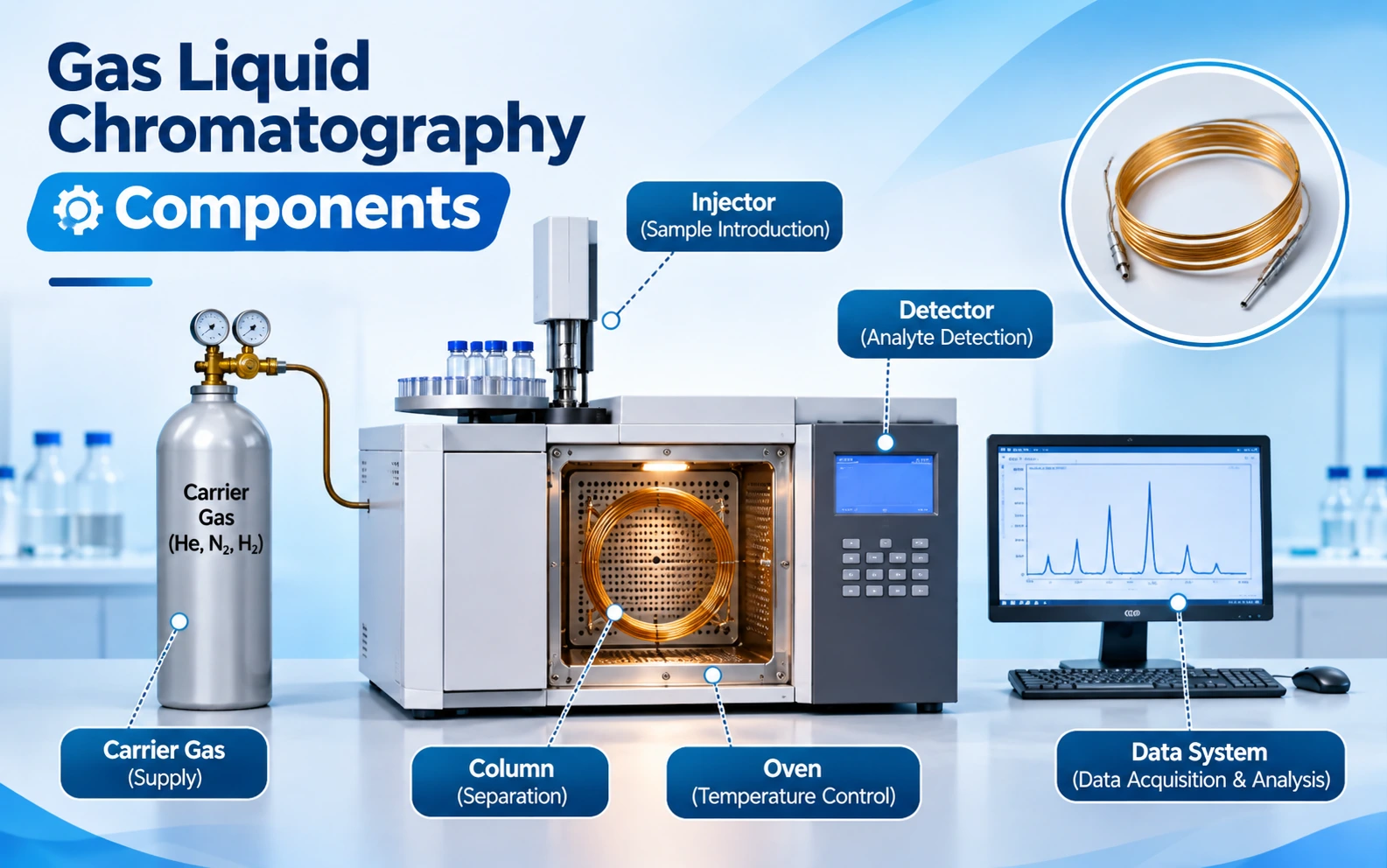
A gas liquid chromatography diagram is a labelled block diagram showing how a sample moves from the carrier gas supply through the injector, column and oven, and detector, to the data system that records the result.
In gas liquid chromatography, every part of the instrument has one job: push the sample along, separate it, detect it and record it. The block diagram of gas chromatography below shows that flow in one glance.
Read it left to right. The carrier gas enters first, the sample is injected into the gas stream, the column separates the mixture inside the oven, and the detector sends a signal to the data system, which draws the chromatogram.
What Are the Components of Gas Liquid Chromatography?
The main components of gas chromatography are the carrier gas supply, injector, column, column oven, detector and data system.
- Carrier gas supply: A cylinder of high-purity inert gas with pressure regulators and flow controllers. This gas is the mobile phase.
- Injector (sample inlet): A heated port that vaporises the sample instantly. It can run in split mode for concentrated samples or splitless mode for trace analysis, and it can be paired with headspace sampling for volatile compounds.
- Column: The heart of the instrument. It carries the liquid stationary phase where separation happens.
- Column oven: Holds the column at a precise temperature or ramps it up during the run.
- Detector: Senses each compound as it leaves the column. Common choices are FID, TCD, ECD and the mass spectrometer used in a GC-MS system.
- Data system: Converts the detector signal into a chromatogram with peaks, retention times and areas.
What Does a Gas Chromatograph Do?
A gas chromatograph separates the components of a volatile mixture, identifies each one by its retention time, and measures how much of each is present.
When people ask what does a gas chromatograph do, the short version is: it answers "what is in this sample and how much?" Labs use it to check drug purity, test food and water, analyse fuels and screen forensic samples. A single run usually takes only a few minutes to an hour.
What Is a Gas Liquid Chromatography Machine?
A gas liquid chromatography machine is a complete gas chromatography system: the instrument body with its oven, injector and detector, plus the gas supply, columns and software that run it.
A typical setup includes the main GC unit, an autosampler for repeat injections, gas cylinders or a gas generator, and a computer with chromatography software. Labs that want a proven, ready-to-run unit often start with the Perkin Elmer Clarus gas chromatography system.
What Are the Mobile Phase and e of the column.
The GC mobile phase only carries the sample; it does not react with it. That is the main difference from liquid chromatography, where the mobile phase takes part in the separation. In the gas chromatography mobile phase and stationary phase pair, all the separation power comes from the stationary phase.
Common stationary phases include:
- Polydimethylsiloxane (non-polar): Good for hydrocarbons and general-purpose work.
- Phenyl-substituted polysiloxane (mid-polar): Suits aromatic compounds and pesticides.
- Polyethylene glycol (polar): Suits alcohols, fatty acids and flavour compounds.
A useful rule is "like dissolves like": match the polarity of the stationary phase to the polarity of your sample.
What Is the Carrier Gas in Gas Chromatography?
The carrier gas is the inert gas, usually helium, hydrogen or nitrogen, that sweeps the vaporised sample through the column to the detector.
A good carrier gas must be chemically inert, very pure, safe to handle and compatible with the detector. Here are the carrier gases in gas chromatography, with advantages and disadvantages:
|
Carrier gas |
Advantages |
Disadvantages |
|---|---|---|
|
Helium |
Inert, safe, works with almost every detector |
Costly and subject to supply shortages |
|
Hydrogen |
Fast runs, high efficiency, can be made by a generator |
Flammable, needs leak safety checks |
|
Nitrogen |
Cheap, safe, easy to source |
Slower runs, lower efficiency at high flow |
If cost is your concern, nitrogen is the budget option and hydrogen is the fast option. Helium remains the most common default in routine labs.
What Is Gas Column Chromatography, and What Types of Columns Are Used?
Gas column chromatography is gas chromatography in which separation happens inside a column, and the types of column used in gas chromatography are packed columns and capillary (open tubular) columns.
|
Feature |
Packed column |
Capillary column |
|---|---|---|
|
Construction |
Tube filled with coated solid support |
Hollow, narrow tube coated on the inner wall |
|
Typical diameter |
2 to 4 mm |
0.1 to 0.53 mm |
|
Resolution |
Moderate |
High |
|
Sample capacity |
High |
Low |
|
Best for |
Simple mixtures, gases |
Complex mixtures, trace analysis |
Capillary columns come in three main forms:
- WCOT (wall-coated open tubular): Liquid phase coated directly on the tube wall.
- SCOT (support-coated open tubular): Wall lined with a layer of support material that holds the liquid phase.
- PLOT (porous-layer open tubular): Wall lined with a porous solid, used for light gases.
When choosing a column, consider stationary phase polarity, length (longer gives better separation but a longer run), internal diameter and film thickness.
What Are the Typical GC Conditions?
Typical GC conditions are the settings you choose for injector temperature, oven programme, carrier gas flow, split ratio and detector temperature, and they must be tuned to your sample.
- Injector temperature: Set high enough to vaporise the sample fully, but below the point where it degrades.
- Oven programme: Start low and ramp up (temperature programming) so that light and heavy compounds both elute with sharp peaks.
- Carrier gas flow rate: Held constant or controlled by pressure, and kept near the optimum for the gas you use.
- Split ratio: Higher for concentrated samples, splitless for trace levels.
- Detector temperature: Kept above the column temperature to prevent condensation.
Strict, documented GC conditions are essential in regulated work such as pharma quality control, where results must be repeatable from day to day.
What Is the Gas Chromatography Method Step by Step?
The gas chromatography method is a repeatable sequence: prepare the sample, set the conditions, inject, separate, detect and interpret the chromatogram.
- Prepare the sample: Dissolve it in a volatile solvent or use headspace for volatiles.
- Set the instrument: Choose the column, carrier gas, oven programme and detector.
- Inject: Introduce a small volume into the heated injector.
- Separate: The carrier gas moves the vapour through the column, where each compound partitions differently.
- Detect: Each compound produces a peak as it leaves the column.
- Interpret: Match retention times to standards to identify compounds, and use peak area to measure quantity.
For teams building or validating new methods, see how this works in practice in R&D laboratories.
Where Can You Buy a Gas Liquid Chromatography System in India?
You can buy refurbished gas chromatography systems from Spectrachrome India for pharma, research, food and environmental labs.
Not sure which configuration, column or detector suits your work? Request a quote and the team will help you choose.
Related Posts
What Is Gas Liquid Chromatography (GLC)? Meaning, Full Form, Principle, Types & How It Works
Learn what gas liquid chromatography (GLC) is, its full form, principle, types, working steps and applications, explained simply with a quick answer for each.
Refurbished UV-Vis Spectrophotometer in India: Performance Checks to Run Before You Buy
Buying a refurbished UV-Vis spectrophotometer in India? Run 6 checks: wavelength, photometric accuracy, stray light, lamp hours, warranty.
Clinical LC-MS/MS in India: Steroid Panels, Drug Monitoring, Vitamin D and Newborn Screening on a Refurbished Triple Quadrupole
A practical guide for lab owners, clinicians and MSc scholars on moving steroid panels, drug monitoring, vitamin D and newborn screening to LC-MS/MS. It covers method validation, NABL accreditation and a 10-point checklist for buying a certified refurbished triple quadrupole