From Thomson's Tube to Today's LC-MS: How a 100-Year-Old Idea Learned to Analyze a Living Cell
Mar 25, 2026
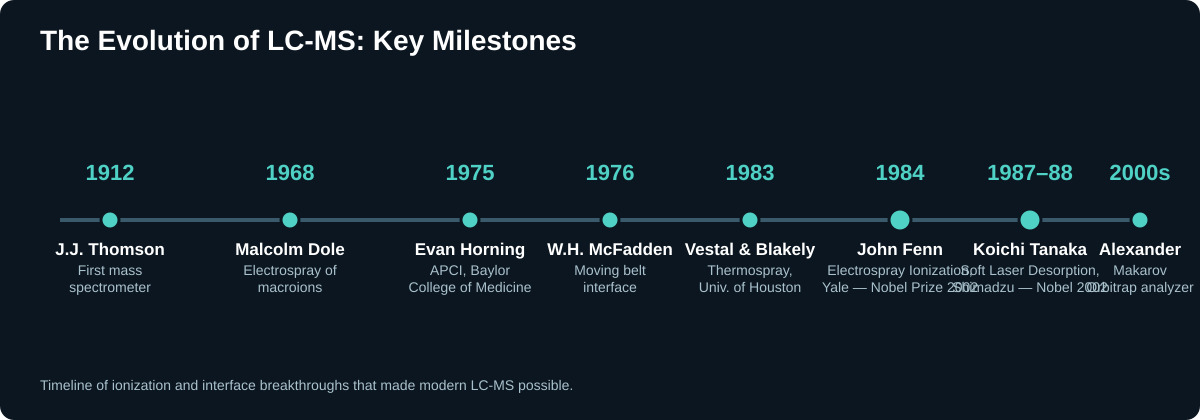
Every LC-MS system sitting in a modern QC lab or pharmacokinetics facility is, in a strange way, the descendant of a glass tube J.J. Thomson was fiddling with in Cambridge in 1912. He wasn't trying to identify drug metabolites or trace pesticide residues. He was trying to figure out what atoms were actually made of. But the basic trick he stumbled onto separate charged particles by their mass-to-charge ratio using electric and magnetic fields is still, in principle, what every mass spectrometer on the market does today.
What's changed isn't the core idea. It's everything around it: how you get a molecule to become an ion without destroying it, and how you get a liquid sample into that process at all. That second problem turned out to be the harder one, and solving it is really the story of how LC-MS came to exist.
The separation half of the equation
Before you can talk about mass spectrometry, you need the "LC" part liquid chromatography to actually separate the components of a mixture first. Modern high-performance liquid chromatography owes a great deal to work done in the 1960s and 70s by researchers refining column packing materials and pump technology to get sharper, faster separations, much of it happening in university chemistry and chemical engineering departments working alongside instrument manufacturers. By the time LC systems were reliable and precise, chemists had a new problem: they had a beautifully separated stream of compounds coming off a column, dissolved in liquid, and no good way to hand that stream over to a mass spectrometer, which fundamentally wants its sample as a gas-phase ion.
That mismatch liquid in, gas-phase ions needed is the entire reason LC-MS didn't exist for decades after both LC and MS were already useful on their own.
Solving the interface problem, one lab at a time
Getting liquid and mass spectrometry to work together took a sequence of genuinely different engineering ideas, developed by different groups, often without knowing exactly who else was working on the same wall.
The moving belt (1976). W.H. McFadden and colleagues built an interface using a continuous belt that carried the LC eluent into the mass spectrometer's vacuum region, evaporating the solvent along the way. It worked, but it was mechanically fussy and never scaled well.
Atmospheric pressure chemical ionization, APCI (1975). Evan Horning and his team at Baylor College of Medicine showed that ions could be generated at atmospheric pressure, outside the mass spectrometer's vacuum chamber, and then pulled in a conceptual shift that made the interface far more practical.
Thermospray (1983). Marvin Vestal and Cal Blakely, working at the University of Houston, developed a source that vaporized the LC eluent through a heated capillary, generating ions largely through a buffer-mediated chemical process rather than harsh fragmentation. For a while, thermospray was the closest thing to a standard LC-MS interface.
Electrospray ionization, ESI (1984). This is the one that changed everything. John Fenn, working in the chemical engineering department at Yale University, built on earlier observations by Malcolm Dole who in 1968 had shown that electrospraying a liquid could produce "molecular beams of macroions" and applied his own background in molecular beam physics to couple electrospray directly to a mass spectrometer. Fenn and his Yale colleague Craig Whitehouse demonstrated that large, fragile biomolecules like proteins could be sprayed from solution into the gas phase as intact, multiply charged ions, without being torn apart in the process. It's hard to overstate how strange that result seemed at the time — spraying a protein through a needle and having it survive intact as an ion. Fenn shared the 2002 Nobel Prize in Chemistry for this work.
Around the same period, on the other side of the Pacific, Koichi Tanaka at Shimadzu Corporation in Kyoto was solving a related but distinct problem how to ionize large biomolecules from a solid or viscous sample using a laser pulse, a technique he called soft laser desorption. Tanaka's 1987–88 results, later developed further by Michael Karas and Franz Hillenkamp into matrix-assisted laser desorption ionization (MALDI), earned Tanaka a share of that same 2002 Nobel Prize alongside Fenn. Between them, ESI and MALDI solved the "how do you ionize something huge and fragile" problem from two completely different directions — one from a liquid, one from a solid and between the two, essentially all of modern biomolecule mass spectrometry became possible.
What the finished instrument is actually doing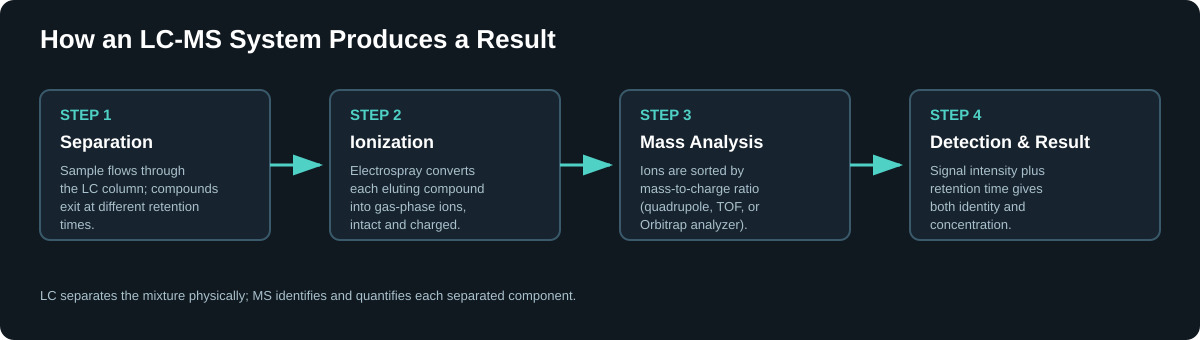
It's worth being concrete about what happens inside a modern LC-MS system, because the history only makes sense once you see the destination.
- Separation. The sample mixture flows through an LC column packed with a stationary phase. Different compounds interact with that stationary phase to different degrees, so they exit the column at different times — this is the retention time, and it's the first piece of identifying information you get.
- Ionization. As each compound elutes, it passes into the ion source — typically electrospray for LC-MS work today — where it's converted into gas-phase ions without falling apart, following essentially the same principle Fenn demonstrated at Yale.
- Mass analysis. The ions are sorted by their mass-to-charge ratio, using anything from a quadrupole to a time-of-flight tube to a high-resolution Orbitrap analyzer (the latter developed by Alexander Makarov in the early 2000s, building on an ion-trapping concept first proposed decades earlier by Kingdon). This is where you get the molecule's mass — often precise enough to narrow down its identity to a short list of possible chemical formulas.
- Detection and quantification. The detector counts ions arriving at each mass-to-charge value, and the resulting signal intensity, tied back to retention time, gives you both identity and concentration.
The reason this combination is so powerful for pharmaceutical, environmental, and clinical work is that neither half does the whole job alone. LC alone can tell you a peak came off the column at a certain time, but two different compounds can easily have similar retention times. MS alone can tell you a compound's mass, but a complex mixture injected directly would produce an unreadable jumble of overlapping signals. Put them together, and you get both a physical separation and a mass-based identification for each separated component — which is why LC-MS became the standard for detecting trace-level compounds in complicated matrices, from blood plasma to river water.
Old instruments, same physics
This is really the point worth sitting with if you're evaluating an older or refurbished LC-MS system. The ionization principle Fenn worked out at Yale in 1984 is the same principle running inside a brand-new electrospray source today. A well-maintained quadrupole from a decade ago is still sorting ions by the same mass-to-charge physics as a current model. What's improved over the generations is largely resolution, scan speed, sensitivity at trace levels, and software — not the underlying idea. An instrument that's been properly requalified against its original performance specifications is still doing the same fundamental job the technique was built to do.
References
- Fenn, J.B., Mann, M., Meng, C.K., Wong, S.F., Whitehouse, C.M. (1989). Electrospray Ionization for Mass Spectrometry of Large Biomolecules. Science, 246(4926). https://doi.org/10.1126/science.2675315 — Chemical Engineering Department, Yale University.
- Dole, M., Mack, L.L., Hines, R.L. (1968). Molecular Beams of Macroions. Journal of Chemical Physics, 49, 2240–2249. https://doi.org/10.1063/1.1670391
- Tanaka, K., Waki, H., Ido, Y., Akita, S., Yoshida, Y., Yoshida, T. (1988). Protein and Polymer Analyses up to m/z 100,000 by Laser Ionization Time-of-Flight Mass Spectrometry. Rapid Communications in Mass Spectrometry, 2(8), 151–153. https://doi.org/10.1002/rcm.1290020802
- The Nobel Prize in Chemistry 2002 — Popular Information. Nobel Foundation. https://www.nobelprize.org/prizes/chemistry/2002/popular-information/
- Tanaka, K. (2003). The Origin of Macromolecule Ionization by Laser Irradiation (Nobel Lecture). Angewandte Chemie International Edition. https://onlinelibrary.wiley.com/doi/abs/10.1002/anie.200300585
- Fenn, J.B. (1990). Electrospray Ionization — Principles and Practice. Mass Spectrometry Reviews, 9(1), 37–70. https://doi.org/10.1002/mas.1280090103 — Yale University.
- The Analytical Scientist. The Top 10 Milestones in MS (covering APCI by Horning et al., Baylor College of Medicine, 1975; thermospray by Vestal and Blakely, University of Houston, 1983). https://theanalyticalscientist.com/issues/2021/articles/nov/the-top-10-milestones-in-ms
- Chromatography Today. The Fascinating History of the Development of LC-MS: A Personal Perspective (covering McFadden's moving belt interface, 1976). https://www.chromatographytoday.com/article/hplc-uhplc/31/unassigned-independent-article/the-fascinating-history-of-the-development-of-lc-ms-a-personal-perspective/601/download
- Wilm, M. (2019). The ever expanding scope of electrospray mass spectrometry — a 30 year journey. Nature Communications, 10, 3958.
- Note: Item 6 traces to Fenn's Yale University-affiliated laboratory; item 1 lists all named authors as members of Yale's Chemical Engineering Department at the time of publication.
Related Posts
HPLC vs UPLC: Which Chromatography System Does Your Lab Actually Need?
In the highly competitive and rigorously regulated world of analytical chemistry, the choice of liquid chromatography instrumentation is one of the mo...
What to Check Before You Buy a Refurbished HPLC System
An HPLC system is really four or five separate instruments bolted together and made to work as one: a pump, an autosampler, a column compartment, a de...