HPLC Instrumentation: Components, Diagram and Working Principle
Nov 9, 2026
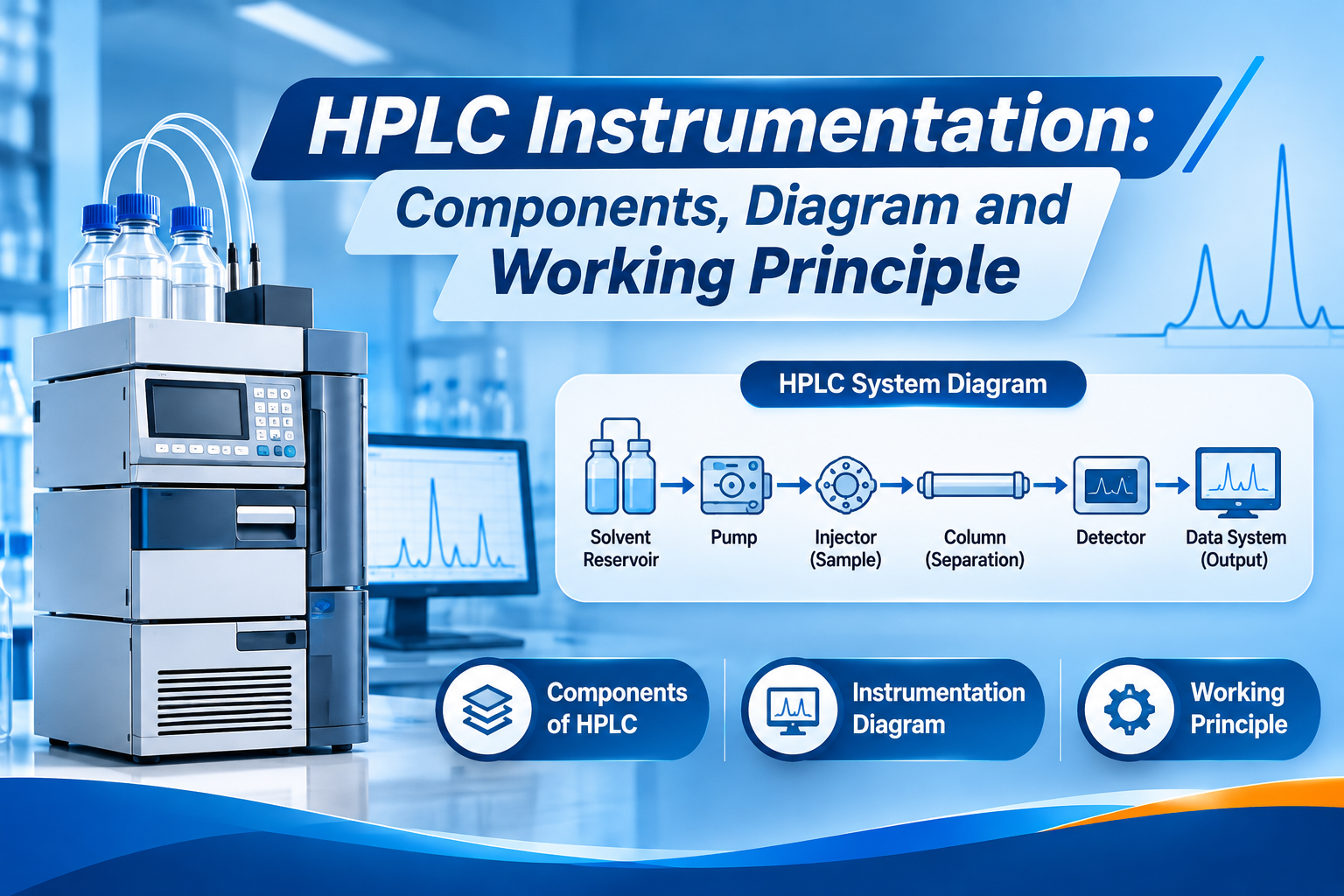
High performance liquid chromatography separates a mixture into its individual compounds and measures each one. To do that, an HPLC system relies on a chain of modules that each do one job: store the solvent, push it through at steady pressure, inject the sample, separate it on a column, detect it and record the result. Understanding HPLC instrumentation helps you read a method, troubleshoot a problem and choose the right system for your lab.
This guide explains the main HPLC components, shows what a typical HPLC diagram looks like, walks through the HPLC working principle step by step and covers how to choose an instrument. Technical details come from manufacturer learning resources, and the sources are listed at the end.
What is HPLC instrumentation?
HPLC instrumentation is the set of modules that together form a high performance liquid chromatography system. According to JASCO's learning centre, a system has five core parts: a pump, an injector, a column, a detector and a data system. Most real systems add a solvent reservoir, a degasser and a column oven, and many add an autosampler.
Each module affects the quality of the result. The pump controls flow and retention time, the column controls separation, the detector controls sensitivity and the data system controls how the signal becomes a number you can report.
What are the main components of an HPLC system?
The table below summarizes the HPLC parts you will find in most systems.
|
Component |
What it does |
|---|---|
|
Solvent reservoirs |
Hold the mobile phase |
|
Degasser |
Removes dissolved gas from the mobile phase |
|
Pump |
Delivers the mobile phase at a precise flow rate and high pressure |
|
Injector or autosampler |
Introduces a measured volume of sample into the flow |
|
Column |
Separates the compounds in the sample |
|
Column oven |
Keeps the column at a stable temperature |
|
Detector |
Measures each compound as it leaves the column |
|
Data system |
Controls the modules and processes the detector signal |
What does the solvent reservoir do?
The solvent reservoirs hold the mobile phase. A method with a constant mobile phase composition (isocratic elution) can use one solvent. A method that changes composition over time (gradient elution) uses several. JASCO notes that most gradient systems use two to four solvents, usually labelled A, B, C and D.
Why does an HPLC system need a degasser?
A degasser removes dissolved gases from the solvents before they reach the pump. According to JASCO, this prevents bubbles that disrupt the pump and interfere with the detector, and it reduces baseline noise, spikes and drift. A bubble-free mobile phase gives a more stable detector signal and more accurate quantitation.
What does the HPLC pump do?
The HPLC pump delivers the mobile phase at a precise flow rate and creates the high pressure needed to push it through a column packed with fine particles. A steady, pulse-free flow is essential for reproducible retention times and peak areas. For conventional analytical methods, JASCO notes that flow rates of about 0.5 to 2.0 mL/min are most common, although the best value depends on the column and the method.
Pumps are grouped by flow rate range. Analytical pumps deliver several mL/min, while preparative pumps deliver tens of mL/min or more, and micro and nano pumps serve very small columns.
How does the HPLC injector or autosampler work?
The HPLC injector puts a precise volume of sample into the flow. A manual injector uses a fixed-volume loop with two valve positions, load and inject. An autosampler automates this step, which JASCO says improves injection precision, enables unattended runs and reduces operator variability. Manual injection suits teaching labs and method development, while autosamplers suit routine QC and high sample throughput.
What does the HPLC column do?
The column is where separation happens, and JASCO calls it the heart of the system. It is packed with a stationary phase that interacts differently with each compound. For routine analysis, JASCO notes that columns of 100 to 150 mm length with 3 to 5 µm particles and a 4.6 mm internal diameter remain the industry standard for conventional HPLC. Common chemistries include reversed-phase, normal-phase, ion-exchange and size-exclusion columns.
Why is a column oven used?
A column oven holds the column at a constant temperature. Temperature changes alter retention time, peak shape and system backpressure, so a stable temperature improves reproducibility. JASCO notes that most reversed-phase methods perform well between 25 °C and 50 °C, within the limits set by the column manufacturer.
How do HPLC detectors work?
HPLC detectors monitor each compound as it leaves the column and convert the measurement into an electrical signal. The common types are:
|
Detector |
How it measures |
Typical use |
|---|---|---|
|
UV/Visible |
Light absorbance |
Compounds that absorb UV or visible light |
|
Photodiode array (PDA/DAD) |
Absorbance with a full spectrum for each peak |
Routine analysis and peak purity checks |
|
Fluorescence |
Emitted light |
Highly sensitive detection of fluorescent compounds |
|
Refractive index (RI) |
Change in refractive index |
Sugars, alcohols and polymers that do not absorb UV |
|
Mass spectrometer (MS) |
Mass-to-charge ratio |
Sensitive detection plus identification |
Most optical detectors use a flow cell, and JASCO notes that the path length typically ranges from 1 to 10 mm. The cell design affects sensitivity and peak broadening.
What does the data system do?
The chromatography data system controls flow, gradients, oven temperature, the autosampler and the detector, while recording the signal in real time. Afterwards, it integrates peaks, calculates retention times and peak areas and produces reports. In regulated labs, it also manages electronic records and audit trails to support requirements such as 21 CFR Part 11.
What does an HPLC diagram look like?
A basic HPLC diagram shows the flow path from solvent to waste. Here is the HPLC flow diagram in words: solvent reservoirs, degasser, pump, injector or autosampler, column in a column oven, detector, then waste, with the data system controlling the modules and recording the signal.
[Insert image here: hplc-instrumentation-diagram.png. Alt text: HPLC diagram showing solvent reservoirs, degasser, pump, injector, column, detector and data system]
You will see the same layout drawn in different ways:
- A HPLC block diagram shows each module as a box with arrows for the flow, as above.
- An HPLC schematic diagram adds valves, mixers, tubing and the sample loop, so it shows how the liquid actually moves.
- An HPLC chromatography diagram often refers to the chromatogram, the output graph of detector signal against time.
An HPLC instrumentation diagram for a gradient system may also show a mixer or gradient valve between the degasser and the pump, which combines the solvents before the column.
What is the working principle of HPLC?
The basic principle of HPLC is that compounds separate because they interact differently with a stationary phase and a mobile phase. According to Shimadzu, the more strongly a compound interacts with the stationary phase, the more slowly it moves through the column. Compounds that interact weakly leave first.
Here is the working of HPLC step by step:
- The pump draws degassed mobile phase from the reservoirs and sends it through the system at a set flow rate.
- The injector or autosampler introduces a measured volume of sample into the flowing mobile phase.
- The mobile phase carries the sample into the column, which sits in an oven at a controlled temperature.
- Inside the column, each compound interacts with the stationary phase to a different degree, so the compounds separate into bands.
- As each band leaves the column, the detector measures it and sends a signal to the data system.
- The data system records a chromatogram. The time at which each peak appears (retention time) helps identify the compound, and the peak area is used to measure how much is present.
What is the difference between reversed-phase and normal-phase HPLC?
The HPLC principle depends on the separation mode. Shimadzu describes reversed-phase chromatography as the most common mode, especially for small molecules. It uses a non-polar stationary phase, typically C18, with a polar mobile phase such as water mixed with methanol or acetonitrile. Polar compounds interact weakly and elute early, while non-polar compounds are retained longer.
Normal-phase HPLC is the opposite. It uses a polar stationary phase and a non-polar mobile phase, so the most polar compounds are retained the longest. Reversed-phase is preferred in most applications because it gives repeatable retention times.
How are HPLC systems configured?
The HPLC working principle is the same for every system, but the hardware can be arranged in two ways.
A modular system is built from separate boxes, usually a pump, autosampler, column compartment and detector stacked together. This makes it easy to replace or upgrade one module. A system such as the Agilent 1100 Series HPLC system follows this layout.
An integrated system combines solvent delivery, the autosampler and often the column heater in a single unit, with a separate detector. The Waters 2695 Alliance HPLC system is an example of this design, and it saves bench space.
What is the difference between isocratic and gradient HPLC systems?
An isocratic system keeps the mobile phase composition constant, so it needs only a simple pump. This suits routine methods with a few components, such as those run on the Waters Isocratic HPLC system.
A gradient system changes the composition during the run to separate complex mixtures. JASCO explains two ways to do this. In low-pressure mixing, valves combine up to four solvents before a single pump, which costs less and is very flexible but has a larger dwell volume. In high-pressure mixing, two or more pumps deliver separate solvents that mix after pressurization, which gives faster gradient response but costs more.
How do I choose HPLC instrumentation for my lab?
Start with the method, then match the hardware to it.
- Sample type and detector: Choose the detector that matches your compounds. UV or PDA covers most routine work, while RI or mass spectrometry suits compounds that do not absorb UV.
- Isocratic or gradient: Routine assays with few components can use an isocratic system. Impurity profiling and complex mixtures usually need a gradient pump.
- Autosampler: Choose one for routine QC and high throughput. A manual injector is enough for teaching and method development.
- Column oven: Needed when retention time reproducibility matters.
- Pressure rating: This varies by manufacturer and model. For example, JASCO describes conventional analytical systems rated up to 70 MPa (about 700 bar) and UHPLC systems up to 130 MPa, while Waters rates the Alliance e2695 to 5,000 psi (345 bar). Methods built for very small particle columns usually need a UHPLC system, and our guide to HPLC vs UPLC explains how to tell which one you need.
- Application: Pharma QC, food, environmental and chemical labs have different documentation and software needs. For example, our article on HPLC in pharmaceutical stability testing shows what regulated work demands from an instrument.
If budget matters, a refurbished system can deliver the same analytical performance at a lower cost, provided it is properly inspected and tested. You can compare options in our refurbished HPLC systems range, and our refurbished HPLC buyers guide lists what to check before you buy.
How do you start an HPLC system correctly?
A consistent startup routine protects the column and the results. JASCO recommends this sequence:
- Prepare HPLC-grade mobile phase and degas it.
- Prime and purge each pump channel to clear trapped air.
- Check the flow path for leaks before installing the column.
- Install the column and equilibrate it until pressure and baseline are stable.
- Warm up the detector and zero it once the baseline is stable.
- Load the method, then run a blank or system suitability injection before analyzing samples.
Frequently asked questions
What are the five main parts of an HPLC system?
The pump, injector, column, detector and data system. Most systems also include a solvent reservoir, degasser and column oven.
What is the basic principle of HPLC in simple terms?
A liquid carries the sample through a column. Compounds that stick more to the column material move slowly, and compounds that stick less move quickly, so they leave at different times and can be measured separately.
Which part of an HPLC is the most important?
The column is often called the heart of the system because separation happens there. However, a stable pump, a clean mobile phase and a suitable detector are all needed for reliable results.
Why is reversed-phase HPLC the most common mode?
It works for a wide range of compounds, especially small molecules, and it gives repeatable retention times with a rugged stationary phase.
Do I need a column oven?
Not for every method, but it improves retention time reproducibility and peak shape, so it is recommended for routine and regulated work.
Conclusion
HPLC instrumentation is a chain of simple modules that each solve one problem: stable flow, bubble-free solvent, precise injection, selective separation, sensitive detection and reliable data handling. Once you know what each part does, reading an HPLC diagram, following the working principle and choosing the right system become much easier.
If you are planning to add or upgrade an HPLC system and want help matching the hardware to your method, request a quote and our team will confirm availability and configuration.