Buying a Refurbished HPLC in India: The 2026 Checklist Before You Pay
Sep 27, 2026
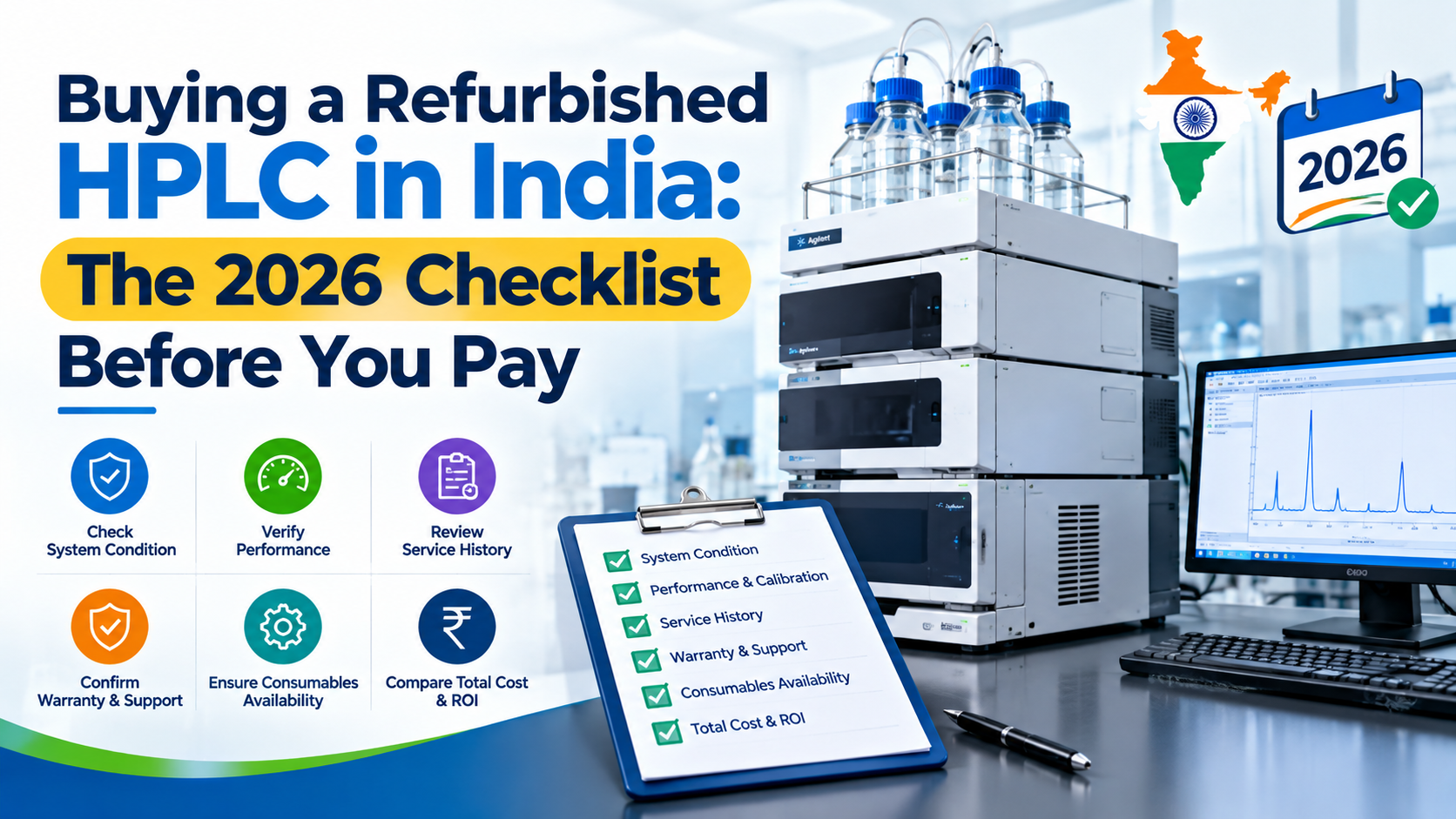
A used HPLC can be a sound, audit-ready purchase or an expensive lesson. The difference is rarely the brand on the front panel. It is what was verified, documented and promised before the invoice was raised. This guide gives you a practical way to compare offers, ask better questions and shortlist a dealer you can trust.
Most Indian laboratories that buy refurbished liquid chromatography equipment are not chasing the lowest number. They are trying to get a validated, supportable system into service quickly, inside a capital budget that a new instrument would strain. That is a reasonable goal. It is also one where the quality gap between suppliers is wide, and a purchase decision made on price alone tends to show its cost six months later in downtime, failed system suitability runs or an audit observation.
Below, we walk through what refurbishment should actually involve, what drives the quote, how the major platforms compare for Indian labs, and an eight-point verification checklist you can hand to your procurement or QA team.
Who should buy refurbished, and who should not
Refurbished systems are a strong fit for routine, method-driven work. That includes pharma and biotech QC-QA labs running assay, related substances and dissolution testing, contract research organisations that need to add capacity without waiting for a long new-instrument lead time, NABL-accredited testing laboratories, food and environmental labs, and academic groups working to a grant budget. In these settings the methods are established, the columns and mobile phases are known, and what you need most is a stable, well-supported platform.
Refurbished is a weaker fit in three situations. If your method development depends on the latest UHPLC pressure range or detector technology, buy new. If a client or regulator contract specifically requires a new-instrument OEM service agreement, buy new. And if you have no access to a competent local service partner, even a very good refurbished system can become a liability, because the value of a used instrument depends heavily on who will keep it running.
What "refurbished" should actually mean
The word is used loosely across the market. Two units can both be sold as refurbished while one has been cleaned and powered on, and the other has been stripped, rebuilt with new wear parts, tested against specification and documented. When you compare quotes, ask which of these levels the supplier is describing.
Cleaned and tested
The instrument is inspected, cleaned and checked to confirm it powers up and pumps. This is the minimum, and it carries the highest risk, because worn seals, check valves and lamps may still be in place.
Serviced with wear parts replaced
Consumable and wear components such as pump seals, plunger seals, check valves, inlet filters, tubing and the detector lamp are replaced, and the module is calibrated. This is the level most buyers should treat as the baseline.
Fully refurbished and qualified
Modules are rebuilt, key parts are replaced with OEM-grade or equivalent components, performance is measured against defined specifications, and a written report is issued. Installation qualification and operational qualification support is available for regulated environments. This is the level to insist on if the system will run release testing or generate data that an auditor will review.
What actually drives the price
Price differences between two apparently similar HPLC systems are usually explained by configuration and support, not by the age of the instrument alone. Before you compare rupee figures, compare what each quote includes.
| Factor | Why it moves the quote |
|---|---|
| Brand and platform generation | Widely deployed platforms such as Waters Alliance, Shimadzu Prominence and LC-10 series, Agilent 1100/1200 and PerkinElmer Series 200 have deep parts and engineer availability in India. |
| Module configuration | Pump type (isocratic, binary or quaternary), autosampler, column oven and detector (UV/PDA, RI, fluorescence) each add to or reduce the total. |
| Refurbishment depth | Replacing seals, valves, lamps and worn parts costs the dealer real money, and it shows in the price and in later reliability. |
| Software and licences | Chromatography data system licensing and a compatible PC can be a large share of the total, especially for compliant setups. |
| Warranty and service response | A longer warranty and faster engineer response cost more to support. |
| Delivery and installation | Insured transit, unpacking, installation and analyst orientation should be priced in or listed as inclusions. |
The most common comparison mistake is putting a full system quote beside a partial one. A low price that leaves out the detector lamp, column oven or software licence is not a saving. Ask every supplier to quote the same configuration, the same warranty and the same inclusions, then compare.
Choosing a platform for Indian laboratories
The best platform is usually the one your team already knows and your region can service. A method transferred from a client or a previous site will run most predictably on similar hardware, and analysts trained on one vendor's software adapt fastest to the same family.
Waters Alliance
Waters systems have a large installed base in Indian pharma, CRO, food and environmental labs, which means experienced service engineers and spares are easier to find. The Alliance line, including the 2695 separations module, is a common choice for regulated QC work, and Waters Empower is widely used for data management in regulated labs. You can browse current stock on our refurbished Waters HPLC systems page, including Alliance 2695 configurations.
Shimadzu
Shimadzu's VP series pumps are valued for baseline stability and low noise, and the platform is common in routine QC and academic labs. For a concrete example of a configured system, see our refurbished Shimadzu LC-10ADVP HPLC, a pulse-free platform from the VP series suited to isocratic and low-pressure gradient work.
Agilent, Thermo Fisher and PerkinElmer
Agilent 1100 and 1200 series systems remain workhorses with good parts availability. Thermo Fisher platforms suit labs that already run Thermo software or mass spectrometers. PerkinElmer Series 200 systems are a practical option where budget is tight and methods are simple. In each case, confirm that your intended detector is available and that the software version runs on a supported PC.
If your lab is also expanding into mass-selective detection, you may want to review a matching GC-MS platform at the same time, such as our refurbished PerkinElmer GC-MS system, so that service, training and documentation come from one supplier.
The 8-point verification checklist
Use this list on every quote. A serious dealer will answer each point without hesitation and in writing.
- Full module list with serial numbers. Ask for pump, autosampler, column oven and detector serial numbers so you can confirm that what arrives matches what was quoted, and so future service records can be tied to specific hardware.
- Measured performance report. Request results for flow accuracy and precision, gradient composition accuracy, injection precision and carry-over, detector noise and drift, and wavelength accuracy where relevant. A single "tested OK" line is not a report.
- Itemised list of replaced parts. Seals, plunger seals, check valves, inlet frits, lamp and tubing should be listed, with a statement of whether parts are OEM or equivalent.
- Installation and qualification support. Confirm who installs the system, whether IQ and OQ documentation is provided, and whether analyst training is included.
- Data integrity readiness. If you operate under 21 CFR Part 11 or ALCOA+ expectations, check the software version, audit trail capability, user access controls and licence validity before you order.
- Warranty terms in writing. Note the duration, what is excluded (columns, lamps and other consumables are commonly excluded), and the stated response time for a breakdown.
- Spare parts and engineer availability. Ask where spares are stocked and how quickly an engineer can reach your city. Response time matters more than the headline warranty length.
- Delivery, packing and transit cover. Pan-India delivery should include insured transit, protective packing and an inspection on unpacking.
Data integrity and compliance considerations
Regulated laboratories should treat compliance as a purchase criterion, not an afterthought. An instrument is only one part of a compliant setup. The chromatography data system, user management, audit trails, backup practice and your own procedures all matter, and an auditor will look at the whole chain.
For refurbished purchases, three points deserve attention. First, confirm that the software you are offered is a licensed, supported version that can be configured for electronic records and signatures if your work requires them. A system can be capable of supporting Part 11 requirements, but compliance ultimately depends on how it is configured and how your lab operates it. Second, check that the operating system and PC hardware are compatible with the software version and that the computer can be secured properly. Third, keep a clean documentation package: the refurbishment report, performance test results, IQ and OQ records, and calibration certificates. These become part of your instrument's life-cycle file.
NABL accreditation depends on validated methods, calibration and qualification records and competent personnel, not on whether an instrument is new. A properly qualified refurbished system with complete documentation can support accredited work, but confirm your specific requirements with your assessor before purchase.
Red flags when comparing dealers
- The quote lists a brand and model but no module-level configuration or serial numbers.
- The test report is a single pass or fail statement with no measured values.
- The warranty is vague, or it excludes the pump and detector, which are the most failure-prone modules.
- The dealer will not say who services the system after delivery.
- Photos are stock images or manufacturer brochure pictures rather than the unit you will receive.
- You are asked to pay in full before any demonstration, inspection or written specification.
- The software licence status is unclear or "to be arranged".
Think in total cost, not purchase price
The purchase invoice is only the first line of what an HPLC costs over its working life. Budget for columns, guard columns, HPLC-grade solvents, filters, vials and septa, replacement lamps, seals and check valves, preventive maintenance visits, calibration, and periodic requalification. A dealer that stocks consumables and offers a maintenance plan can lower your operating cost and reduce downtime, because parts arrive in days rather than weeks.
Ask whether the supplier also provides repair and preventive maintenance services for pumps, degassers and autosamplers. A single accountable partner for both the instrument and its upkeep simplifies life for a busy QC manager.
Questions to send every dealer
- Which exact model, configuration and software version am I buying?
- What was replaced during refurbishment, and can I see the report?
- What does the warranty cover, for how long, and who visits when something fails?
- Can you support IQ and OQ and my compliance requirements?
- What is the delivery timeline to my city, and what happens if the unit arrives damaged?
- Can you supply columns, lamps, seals and other consumables after the sale?
- Can I see the instrument running before I pay?
A realistic buying timeline
Most purchases follow a similar path. Start by defining your application, throughput and detector requirement, then shortlist two or three platforms. Request written quotes on an identical configuration, review the test documentation, and arrange a demonstration. After you place the order, allow time for packing and transit, installation, qualification and analyst orientation. Building this into your project plan avoids the common situation where a system arrives but sits idle waiting for a qualification slot or a software licence.
New versus refurbished: a quick decision guide
| Choose refurbished if | Choose new if |
|---|---|
| Your methods are established and run on proven platforms | You need the latest detector or UHPLC performance |
| Capital budget is limited or lead time is short | Your contract mandates a new-instrument OEM service plan |
| You need a second system for capacity or backup | You have no access to a trusted local service partner |
| You have a supplier who documents and supports the unit | You cannot obtain documentation for the refurbished unit |
Related Posts
Pharmaceutical Stability Testing Using HPLC: ICH Guidelines
Imagine a lifesaving drug sitting on a pharmacy shelf in the blistering summer heat of New Delhi, or navigating the humid monsoons of Mumbai. How do r...
HPLC vs UPLC: Which Chromatography System Does Your Lab Actually Need?
In the highly competitive and rigorously regulated world of analytical chemistry, the choice of liquid chromatography instrumentation is one of the mo...
What to Check Before You Buy a Refurbished HPLC System
An HPLC system is really four or five separate instruments bolted together and made to work as one: a pump, an autosampler, a column compartment, a de...