What to Check Before You Buy a Refurbished HPLC System
Jun 9, 2026
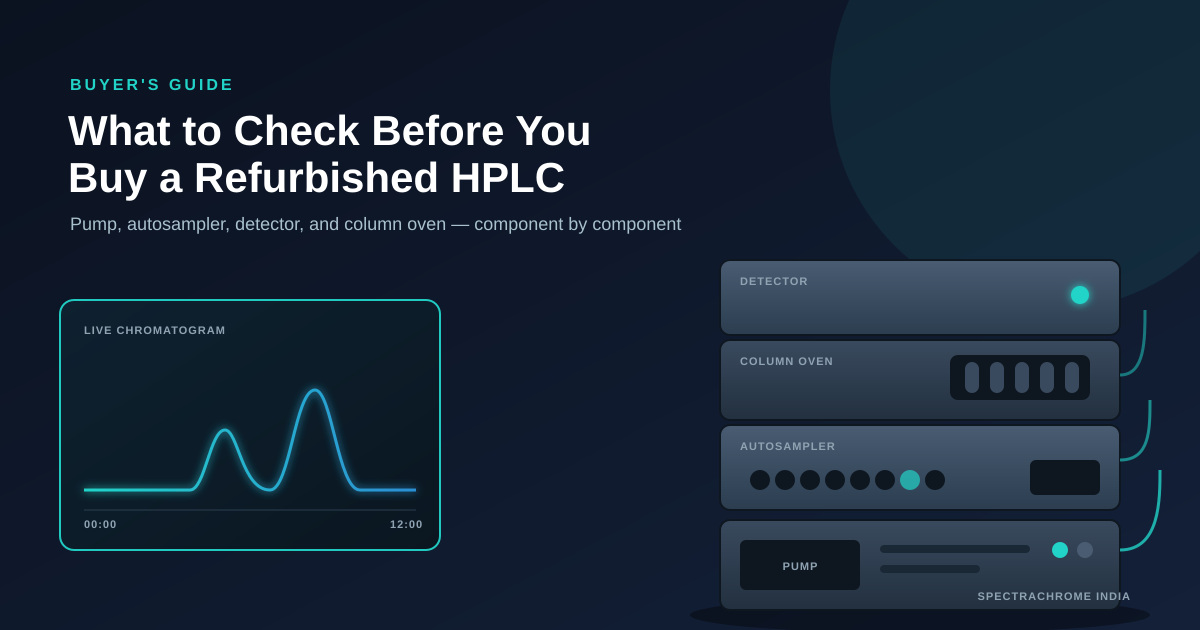
An HPLC system is really four or five separate instruments bolted together and made to work as one: a pump, an autosampler, a column compartment, a detector, and the software that ties them together. When you buy a refurbished HPLC, you're not buying one used thing you're buying five things with five different wear patterns, five different failure modes, and five different questions worth asking before you sign a purchase order.
That's the part a lot of buyers miss. It's easy to ask "does it turn on and run a sample?" and treat a successful demo as proof the whole system is sound. The more useful approach is to walk through each module on its own terms, because a pump with 20,000 hours of runtime and a detector with a fresh lamp can sit in the very same chassis, and knowing the difference is what separates a good refurbished purchase from an expensive mistake.
Why refurbished HPLC makes financial sense in the first place
A new analytical HPLC system typically runs anywhere from roughly $20,000 to $70,000 depending on configuration a real capital commitment for most labs, especially smaller QC operations, academic departments, or contract testing labs watching budgets closely. Refurbished systems from established brands like Agilent, Waters, and Shimadzu routinely sell for a fraction of that, while running on exactly the same separation science described in pharmacopoeial methods. The core physics of liquid chromatography doesn't have a model year. What varies enormously is how well the individual components have been maintained, tested, and in some cases replaced before the system reaches you.
The pump: ask about seals, pistons, and service history
The pump is the heart of an HPLC system, delivering a consistent and reproducible flow rate of mobile phase through the column. Pump designs have changed relatively little in their basic operating principle over the years, even as operating pressures have climbed with the shift toward UHPLC which is actually good news for refurbished buyers, since an older pump isn't running on outdated engineering, just lower peak pressure capability.
What you specifically want to know:
- Have the pump seals been replaced? Seals are a wear item, not a lifetime component, and worn seals are one of the most common sources of pressure instability and leaks.
- What about the pistons? Sapphire pistons are a common upgrade during quality refurbishment; ask specifically whether the original pistons were kept or replaced.
- Is there a documented service history? A pump coming from a lab that maintained it on a regular schedule is a fundamentally different purchase than one pulled from an unknown source with no maintenance record.
- Any signs of leakage? This is something you can and should ask to see directly, either in person or via video, before purchase.
The autosampler: injection accuracy and contamination history
Autosamplers bring the sample into the mobile phase stream with far better accuracy and repeatability than manual injection, and they're now standard equipment on nearly every HPLC system sold. Because the autosampler is the part of the system that directly touches your sample, its prior use matters more than buyers often realize.
Worth asking:
- What sample types ran through this autosampler previously? An instrument that spent its life running clean aqueous pharmaceutical standards has a very different history than one used for complex environmental or industrial matrices.
- How was it decontaminated before resale? A reputable refurbisher should have a clear, describable cleaning and decontamination process, not a vague assurance.
- Have the needle, seat, and rotor seals been replaced? These are the components most directly responsible for injection precision and carryover, and they're consumable by design.
The detector: the component most likely to define your data quality
Whether your system uses a variable wavelength detector, a diode array detector, a fluorescence detector, or a mass-selective detector, this is the component that ultimately produces your data. A tired detector lamp or a poorly maintained flow cell can quietly degrade sensitivity in ways that don't show up as an obvious fault the instrument still "works," it's just not as sensitive as it should be.
Ask specifically:
- Has the detector lamp been replaced? Lamps degrade with use and are a standard consumable in any serious refurbishment process.
- Can you see baseline noise and drift data? This is a direct, quantifiable way to assess detector condition, and any refurbisher confident in their work should be willing to share it.
- What's the flow cell's condition? Flow cell contamination or scratching directly affects both noise and photometric accuracy.
The column compartment and degasser: easy to overlook, worth checking anyway
The column oven keeps separation temperature stable, which matters more than it sounds like it should retention time reproducibility depends on it. The degasser removes dissolved gas from the mobile phase to prevent bubbles that disrupt baseline stability. Neither gets discussed as often as the pump or detector, but a column oven that can't hold temperature accurately, or a degasser that's stopped degassing effectively, will quietly undermine an otherwise well-refurbished system.
Evaluating the refurbisher, not just the instrument
It's easy to spend all your evaluation effort on the machine and none of it on the business selling it, but the two are inseparable. A refurbished HPLC system is only as good as the process that produced it, and that process is invisible unless you specifically go looking for evidence of it.
A comprehensive rebuild process addresses every aspect of system performance, not just the obvious problems a technician can spot on a walkthrough. It typically begins with complete disassembly and thorough inspection of every module, followed by a detailed assessment that identifies which components need replacement, which need recalibration, and where performance can be optimized beyond simply restoring factory-original specification. This is meaningfully different from basic reconditioning, which often amounts to cleaning the exterior, replacing anything visibly broken, and running a single demo sample to confirm the system powers on and produces a peak.
A few signals that tend to separate a serious refurbisher from a reboxing operation:
- They can name specific replaced parts, not general categories. "We replaced the pump seals and detector lamp" is a real answer. "It's been fully refurbished" without specifics is not.
- They test against performance specifications, not just functionality. A system that "turns on and runs" has cleared a much lower bar than one verified against wavelength accuracy, photometric accuracy, and noise specifications.
- They're willing to let you (or your technician) inspect the system before finalizing, in person or via detailed video. Reluctance here is a meaningful red flag.
- They can speak to the instrument's prior application history. Even an approximate answer pharmaceutical QC, academic research, industrial process monitoring tells you something about wear patterns and contamination risk.
Matching the system to your actual application
Not every lab needs the same HPLC configuration, and refurbished systems give you more flexibility here than buying new, precisely because the price difference makes it more affordable to match specification to need rather than buying the most capable system available. Analytical HPLC systems, suited to routine sample analysis, are the most common configuration and the most widely available on the refurbished market. Preparative systems, designed to isolate and purify larger quantities of a compound, are a different animal mechanically and worth specifying clearly when you start shopping. High-throughput systems built around large-capacity autosamplers suit labs processing high sample volumes on a routine basis. UHPLC systems, running at substantially higher pressures with sub-2-micron columns, offer faster runs and sharper resolution, but not every lab's method requires that capability, and UHPLC-capable refurbished units command a real price premium over standard analytical systems.
The detector configuration matters just as much as the pump and column setup. UV-Vis and diode array detectors cover the majority of routine pharmaceutical, food, and environmental applications. Fluorescence detectors offer far greater sensitivity for compounds that fluoresce naturally or after derivatization. Refractive index detectors serve applications, like sugar or polymer analysis, where the analyte doesn't absorb UV light at all. And mass-selective detectors, effectively turning the system into an LC-MS, provide the most discriminating identification but come with a substantially higher price tag and different maintenance considerations entirely. Getting this match right before you shop narrows the field considerably and helps you avoid paying for capability you won't use.
What documentation to actually request
This is where many buyers stop too early, accepting a working demo as sufficient proof. A demo shows the system functions; it doesn't show that it meets performance specifications. Ask specifically for:
- An Installation Qualification / Operational Qualification (IQ/OQ) report generated after refurbishment, not carried over from the instrument's original manufacture date.
- A documented list of which components were replaced during the refurbishment process — pump seals, pistons, detector lamp, autosampler seals, tubing, and filters are the ones that matter most.
- Baseline performance data: noise, drift, and, where applicable, wavelength and photometric accuracy results.
- Warranty terms in writing — specifically what's covered (parts, labor, or both) and for how long.
Quality refurbishers replace components based on performance specifications rather than only visibly obvious wear, which is a meaningfully different (and better) standard than basic reconditioning. That distinction is usually visible in how willing a seller is to document what they did and why.
Realistic cost expectations
New analytical HPLC systems generally fall between roughly $20,000 and $70,000 depending on configuration, detector type, and whether it's a standard analytical, preparative, or UHPLC system. Refurbished systems typically run well below that range for equivalent capability, which is the core financial argument for going refurbished in the first place — provided the requalification work has actually been done properly. The tradeoff to budget for isn't just the purchase price; it's factoring in what warranty coverage and post-sale support cost compared to what a manufacturer would provide on a new unit, since that support has to come from the refurbisher instead.
Frequently Asked Questions
Q: Is a refurbished HPLC system reliable enough for regulated pharmaceutical QC work?
A: Yes, provided it comes with proper IQ/OQ documentation generated after refurbishment and meets the performance criteria your specific pharmacopoeial method requires. The separation chemistry and detection physics don't change based on the instrument's age; what matters is whether the individual components have been verified to spec.
Q: How do I know if the pump seals were actually replaced, or if the seller is just saying so?
A: Ask for it in writing as part of the refurbishment documentation, ideally with a component replacement log. A refurbisher confident in their process will provide this without hesitation; reluctance to document specifics is itself useful information.
Q: Should I worry about buying an older HPLC model that the manufacturer no longer actively supports?
A: It's worth checking replacement part availability before purchase, since that's the main practical risk with older models. Popular workhorse models from Agilent, Waters, and Shimadzu tend to have a long aftermarket parts supply, but it's worth confirming for the specific model you're considering.
Q: What's a reasonable warranty period to expect on a refurbished HPLC system?
A: This varies by seller, but you should get warranty terms in writing before purchase, specifying exactly what's covered — parts, labor, or both — and for how long. Treat vague or verbal-only warranty assurances as a red flag.
Q: Can a refurbished HPLC system be upgraded later, for example by adding a UHPLC-capable pump?
A: In many cases, yes, particularly for modular systems where the pump, detector, and autosampler are separate units rather than a fully integrated chassis. It's worth asking the seller directly about upgrade paths if you anticipate needing higher pressure capability down the line.
Q: What's the single most important question to ask before buying?
A: "Can I see the post-refurbishment OQ report?" If a seller can produce this without delay, it tells you the refurbishment was done to a documented standard rather than a cosmetic once-over.
The bottom line
A refurbished HPLC system can perform every bit as reliably as a new one, because the pump, autosampler, and detector are all working on the same established engineering and chemistry regardless of manufacture year. What determines the outcome is whether each component was actually inspected, tested, and where needed replaced against a documented standard — not just wiped down and reboxed. Ask for the data on each module separately. A seller with nothing to hide will have it ready.
References
- AIM Analytical. A Complete Buying Guide for Refurbished HPLC Systems.
- Lab Merchant. Used HPLC Systems For Sale Pumps and Autosamplers Guide.
- AIM Analytical. Top of The Line Refurbished Agilent HPLC Lab Systems.
- Arc Scientific. Comprehensive Guide to HPLC Systems: Cost, Suitability, and Best Models.
- EquipNet. Used HPLC Systems Certified Pre-Owned Instrument Programs.
- Cambridge Scientific. New, Used & Refurbished HPLC Systems.
Related Posts
Gas-Liquid Chromatography for Pharma QC in Hyderabad
Gas-Liquid Chromatography for Pharma QC in Hyderabad: Residual Solvents, Validation and Audit-Ready Setup Walk through the QC laboratory of almost an...
Gas-Liquid Chromatography for Bangalore R&D and Startup Labs
Setting up a lab in Bangalore? Learn how to choose GLC columns, detectors and a budget-smart refurbished GC for R&D, biotech and food-testing work.
Buying a Refurbished HPLC in India: The 2026 Checklist Before You Pay
Refurbished HPLC buyer's guide for Indian labs: pricing factors, test reports, warranty checks and dealer questions.