Clinical LC-MS/MS in India: Steroid Panels, Drug Monitoring, Vitamin D and Newborn Screening on a Refurbished Triple Quadrupole
Oct 25, 2026
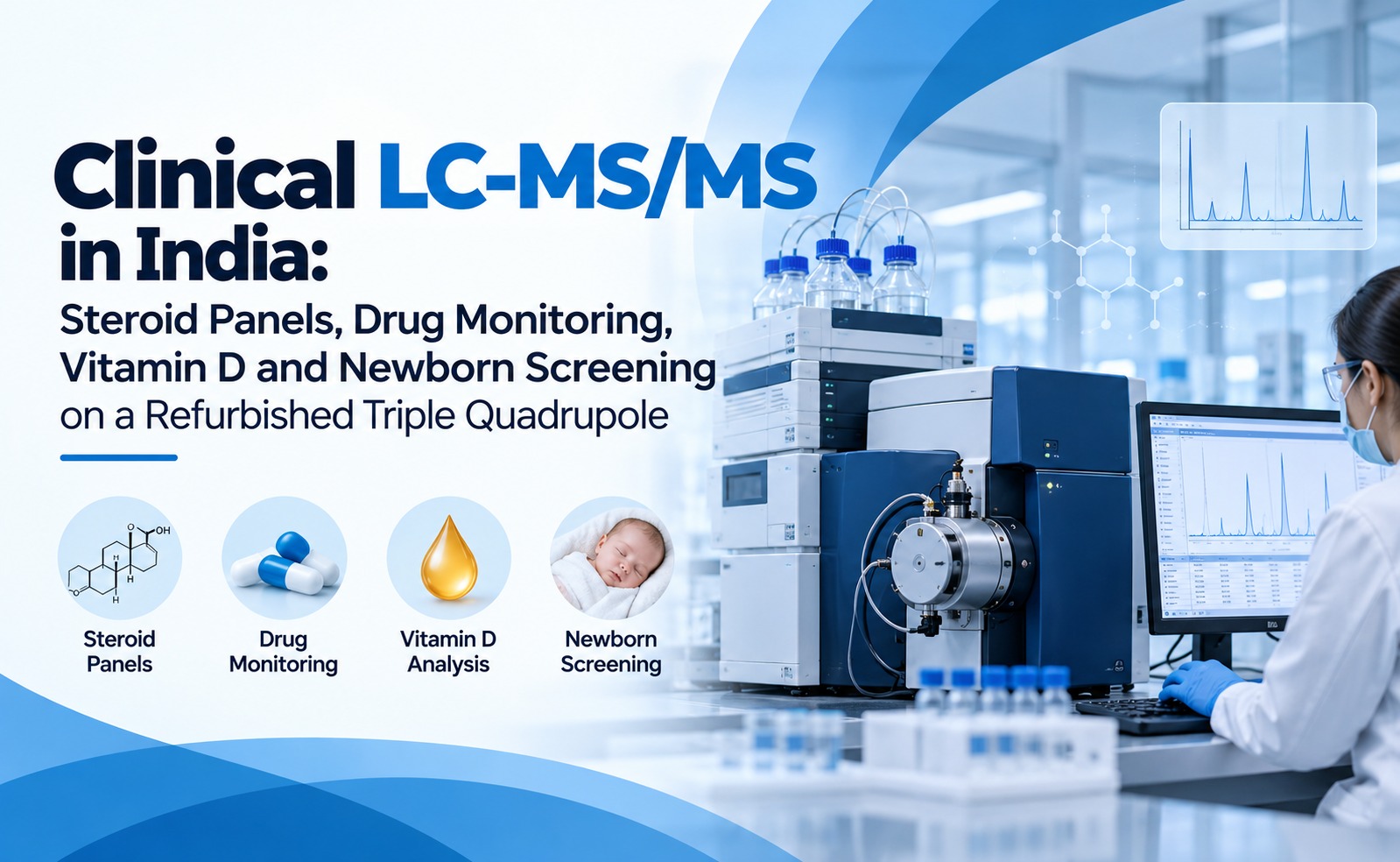
For many Indian diagnostic laboratories, the question is no longer whether LC-MS/MS belongs in clinical practice. The question is which assays to move first, how to validate them to an accreditation standard, and how to fund the instrument. A certified refurbished triple quadrupole is now a realistic route for independent labs, hospital pathology departments and university research cores.
Why clinical labs are moving to LC-MS/MS
Immunoassays are fast and automated, but they depend on antibody specificity. For small molecules such as steroid hormones, structurally similar compounds can cross-react, and results at low concentrations become unreliable. Published reviews on steroid analysis describe mass spectrometry as offering better specificity than immunoassay, with LC-MS/MS matching GC-MS for accuracy, precision and sensitivity while needing simpler sample preparation.
The second driver is the panel. Clinicians increasingly ask for a profile of several analytes rather than a single value. One LC-MS/MS run can quantify many compounds from a small serum volume, which is difficult to achieve with separate immunoassay kits.
The third driver is local. Large Indian reference laboratories have already put LC-MS into routine use for vitamins, steroid panels and metabolic testing, and public-sector hospitals have floated tenders for LC-MS systems dedicated to therapeutic drug monitoring. Demand for these tests is moving from metro reference labs into regional and hospital settings.
Four assays that justify the investment
| Assay group | Clinical question | Why LC-MS/MS |
|---|---|---|
| Steroid hormone panels | Adrenal disorders, hypogonadism, congenital adrenal hyperplasia, PCOS work-up | Separates structurally related steroids; one run reports several analytes |
| Therapeutic drug monitoring | Dose adjustment for immunosuppressants, antiepileptics, antifungals and antibiotics | Narrow therapeutic windows need accurate, interference-free numbers |
| 25-hydroxy vitamin D | Deficiency, bone and endocrine disorders | Quantifies 25OHD2 and 25OHD3 separately |
| Newborn screening by tandem MS | Inborn errors of amino acid, fatty acid and organic acid metabolism | One dried blood spot can screen for many disorders in a single test |
A note for transplant and surgical teams
After solid organ transplantation, calcineurin and mTOR inhibitors such as tacrolimus, cyclosporine, sirolimus and everolimus need dose adjustment against measured blood levels. Surgeons and transplant physicians depend on turnaround time as much as accuracy. A hospital with an in-house LC-MS/MS can return results in hours, where send-out testing takes days.
A note for MSc and research scholars
If your thesis involves bioanalytical method development, a clinical-grade triple quadrupole teaches the full chain: sample preparation, chromatography, MRM optimisation, internal standards, calibration and validation. Refurbished systems let a department equip a teaching and research core at a fraction of new-instrument cost.
Immunoassay versus LC-MS/MS: an honest comparison
| Factor | Immunoassay analyser | LC-MS/MS |
|---|---|---|
| Specificity for small molecules | Depends on antibody; cross-reactivity possible | Mass-based detection plus chromatographic separation |
| Multi-analyte panels | Separate reagent per analyte | Many analytes in one injection |
| Throughput | High, fully automated | Moderate; depends on run time and sample preparation |
| Operator skill | Routine technician | Trained analyst with method knowledge |
| Cost per test at scale | Reagent driven | Lower consumable cost once volume is established |
| New test development | Wait for a kit | Develop and validate in-house |
What validation demands
Buying the instrument is the easy part. A clinical method must be validated before patient reporting. The widely used framework for this is the CLSI guidance on LC-MS methods in the clinical laboratory, and Indian labs seeking accreditation will map their work to ISO 15189 as applied by NABL. Typical validation covers:
- Accuracy and precision across the measuring range, within-run and between-run.
- Linearity and lower limit of quantification at clinically relevant decision levels.
- Matrix effects and ion suppression, assessed with post-column infusion or post-extraction spiking.
- Isotope-labelled internal standards to correct for extraction loss and ionisation variability.
- Carryover, specificity and interference from lipids, haemolysis, icterus and co-administered drugs.
- Calibrator traceability and proficiency testing, because LC-MS methods can differ between laboratories unless harmonised.
- Stability studies for samples and extracts under real storage conditions.
Confirm with your accreditation body and applicable regulations how in-house developed methods and commercial kits are to be documented for your laboratory.
Buying a refurbished triple quadrupole: the inspection checklist
A refurbished system can be an excellent value, provided the seller proves its condition with data rather than adjectives. Ask for the following before you commit.
- Sensitivity proof. A recent signal-to-noise result for a standard test compound in your ionisation mode, run on the system you will receive.
- Mass accuracy and resolution. A calibration report across the working mass range, with stable peak shape on both quadrupoles.
- Vacuum system history. Turbo pump hours, backing pump service record and achieved vacuum levels.
- Ion source and optics. Condition of the source, capillary or spray components, and the collision cell. Ask which parts were replaced.
- Detector life. Detector voltage trend or gain test to estimate remaining life.
- LC front end. Pump pressure ripple, autosampler injection precision and carryover, and column oven stability.
- Software and data integrity. Supported operating system, audit trail, user access control and electronic record features, since a clinical lab needs defensible records.
- Parts and service. OEM parts availability for your brand and model, consumables supply, and how quickly an engineer can reach your city.
- Qualification support. Installation, operational and performance qualification documents delivered with the system.
- Warranty terms in writing. What is covered, for how long, and what is excluded.
Which OEM platform?
Clinical labs commonly run triple quadrupole platforms from Waters, Shimadzu, Agilent, Thermo Fisher and others. The better choice is usually the one with strong local service coverage, available kits and application support in your city, and compatible software your analysts already know. Brand loyalty matters less than uptime.
Planning the lab around the instrument
- Power and gas. Stable power with a suitable UPS, a nitrogen supply (generator or cylinders) and a vented exhaust for the source.
- Sample preparation. Protein precipitation, supported liquid extraction or solid-phase extraction, chosen by analyte and throughput.
- People. At least two trained analysts, so a single resignation does not stop the service.
- Quality system. SOPs, internal quality control with multiple levels, external quality assessment and an out-of-control action plan.
- Test menu roadmap. Start with one or two high-volume assays, prove turnaround time and quality, then add panels.
Frequently asked questions
Is a refurbished LC-MS/MS acceptable for a clinical laboratory?
Accreditation assessors examine your validated method, quality control and documentation, not whether the instrument was new. A properly refurbished, qualified system with service support can meet these needs.
How long does method validation take?
It depends on the number of analytes, the availability of calibrators and internal standards, and the experience of the team. Plan for weeks rather than days, and do not rush the matrix effect and interference studies.
Can one instrument run all four assay groups?
Yes, with scheduling. Different assays may need different columns, mobile phases and source settings, so most labs dedicate days or batches to each assay group.
References
- CLSI guidance on liquid chromatography-mass spectrometry methods in the clinical laboratory
- ISO 15189, Medical laboratories: requirements for quality and competence, as applied through NABL accreditation
- Published review on LC-MS/MS steroid paneling in clinical laboratories
- Shimadzu case study: Thyrocare Technologies on mass spectrometry in a clinical lab
- Waters Corporation clinical diagnostics LC-MS/MS webinar series
- Tecan multi-steroid profile LC-MS case study, Labor Berlin
- LC-MS/MS-based diagnostics market report, 2024 to 2034
- GeM tender notice for an LC-MS system for therapeutic drug monitoring, AIIMS Jodhpur
Related Posts
What Is Gas Liquid Chromatography (GLC)? Meaning, Full Form, Principle, Types & How It Works
Learn what gas liquid chromatography (GLC) is, its full form, principle, types, working steps and applications, explained simply with a quick answer for each.
Gas Liquid Chromatography: Components, Diagram, Columns, Carrier Gas & Mobile Phase
See a gas liquid chromatography diagram and learn its components, column types, carrier gases, mobile phase, GC conditions and method in simple steps.
Refurbished UV-Vis Spectrophotometer in India: Performance Checks to Run Before You Buy
Buying a refurbished UV-Vis spectrophotometer in India? Run 6 checks: wavelength, photometric accuracy, stray light, lamp hours, warranty.