Refurbished UV-Vis Spectrophotometer in India: Performance Checks to Run Before You Buy
Oct 30, 2026
What is a refurbished UV-Vis spectrophotometer?
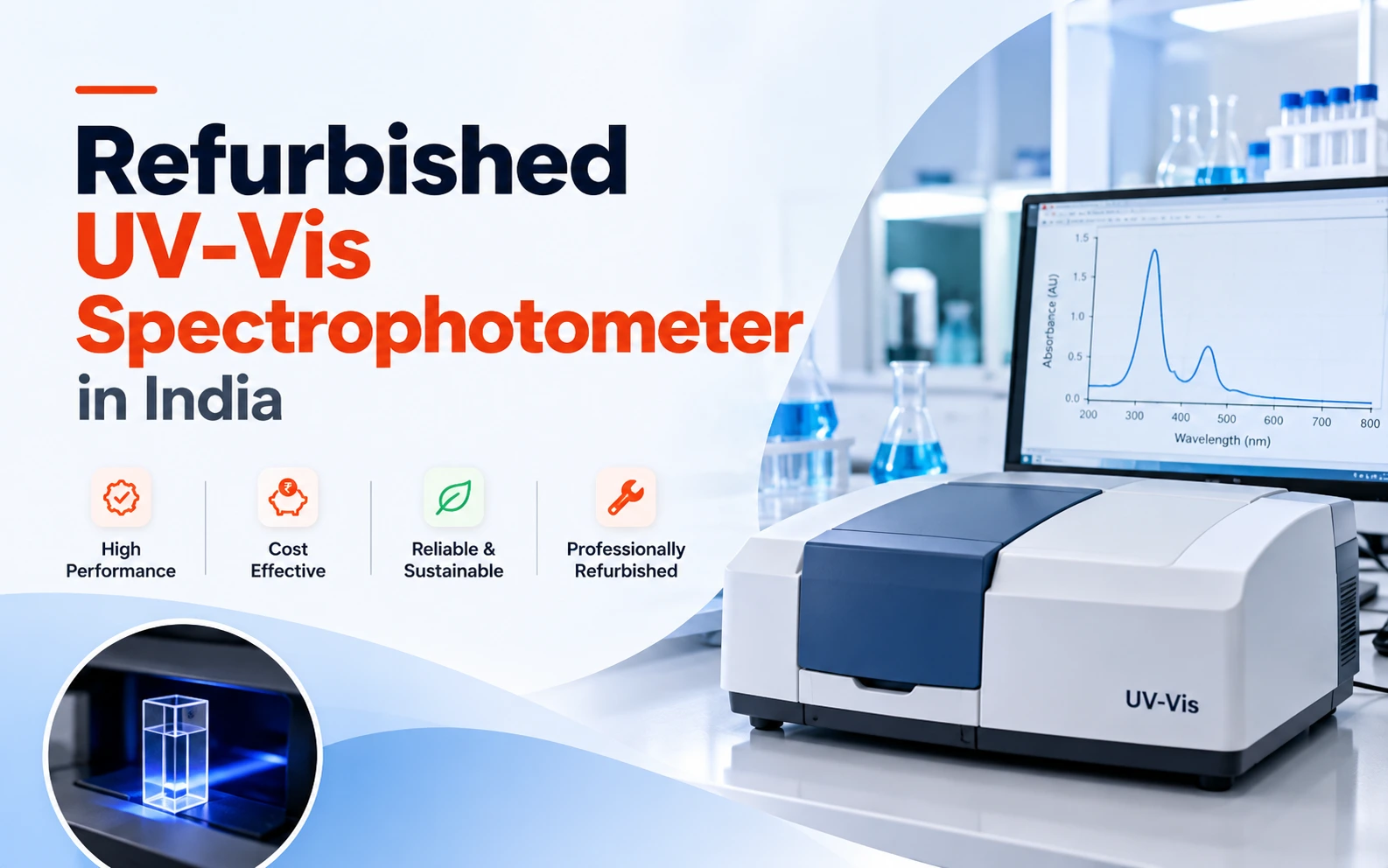
A refurbished UV-Vis spectrophotometer is a used instrument that has been inspected, repaired, fitted with worn parts such as lamps, tested against performance criteria and calibrated before resale. This is different from a used or second hand UV spectrophotometer sold as it is, which comes with no test data. For buying a refurbished UV-Vis spectrophotometer in India, that difference decides whether you get a working asset or a repair bill.
These instruments measure how much light a sample absorbs between roughly 190 and 1100 nm. A deuterium lamp covers the ultraviolet range, a tungsten-halogen lamp covers the visible range, a monochromator selects the wavelength and a detector reads the transmitted light. A double beam UV-Vis spectrophotometer splits the light into sample and reference paths, which gives better stability for pharma work.
Is a refurbished UV-Vis spectrophotometer acceptable for pharma QC and NABL labs?
Yes, when it passes performance verification. Assessors and auditors look at your UV-Vis calibration records, your qualification documents (IQ, OQ, PQ) and your routine checks. They do not look at whether the instrument was bought new. Pharmacopoeial methods for UV-Vis performance, such as those in USP, the European Pharmacopoeia and the Indian Pharmacopoeia, define what you must demonstrate, so use the current edition your lab follows to set pass limits.
UV-Vis often works beside chromatography in a QC lab. If your lab also runs pharmaceutical stability testing with HPLC, the same documentation discipline applies to both instruments.
Practical rule: if a seller cannot show you a measured result for each performance check below on the exact unit you will receive, treat the claim "tested and working" as unverified.
Refurbished UV-Vis spectrophotometer price in India
The refurbished UV-Vis spectrophotometer price in India depends on brand, model age, optical system, lamp and detector condition, software and warranty. Public marketplace listings in October 2026 showed refurbished double-beam units from several sellers at roughly ₹1 lakh to ₹3 lakh, with older single-beam and visible-only units priced lower. Treat this as an indicative range only.
- Very low prices often mean no warranty, no software or a worn lamp and detector.
- Brand and model matter: Shimadzu instruments, PerkinElmer systems and Agilent systems have wide parts and software support, along with Thermo Fisher.
- Compare total cost: add lamp replacement, calibration, cuvettes, a PC if needed and service visits.
You can browse our UV-Vis spectrophotometer category to compare current models.
Six performance checks to run before you buy
These checks follow the usual structure of pharmacopoeial UV-Vis verification. Ask the seller to run them in front of you, or to provide dated results with the certified reference materials used.
|
Check |
How it is tested |
What you are looking for |
|---|---|---|
|
Wavelength accuracy |
Holmium oxide filter or solution; deuterium lamp emission lines near 486 nm and 656 nm |
Measured peak positions within the tolerance of your pharmacopoeia or the maker's specification |
|
Photometric accuracy |
Potassium dichromate solution in dilute acid at several wavelengths, or certified neutral density filters |
Absorbance readings within limits at low and high absorbance |
|
Stray light |
Potassium chloride solution at 198 nm, sodium iodide at 220 nm, or sodium nitrite at 340 and 370 nm |
Absorbance above the pass limit, which shows the instrument blocks unwanted light |
|
Resolution |
Toluene in hexane (0.02% v/v), ratio of the absorbance maximum near 269 nm to the minimum near 266 nm |
A ratio that meets the pharmacopoeial limit for the bandwidth in use |
|
Baseline noise |
Scan or time-based measurement with air or blank in both beams |
Low, stable noise compared to the manufacturer's specification |
|
Baseline drift and flatness |
Baseline scan across 200 to 800 nm and drift over time after warm-up |
Flat baseline, no steps at lamp changeover and minimal drift |
Why stray light deserves extra attention
Stray light limits the highest absorbance you can trust. A worn grating, a dirty optical path or an ageing lamp can raise it. High stray light makes concentrated samples read lower than they are, which hurts assay accuracy. It is the test that old instruments fail most often.
Check wavelength accuracy across the range
Do not accept a single-point check. Verify wavelength accuracy in both the UV and visible regions, and confirm the instrument returns to the same wavelength after scanning in both directions.
Lamp, detector, cuvette holder and software
Deuterium lamp life and tungsten lamp condition
A deuterium lamp typically lasts on the order of 1,000 to 2,000 hours, so ask for the lamp hours counter reading and the date the lamp was replaced. Weak UV energy, noisy baselines below 250 nm and long warm-up times point to a lamp at its end. Some models use xenon flash lamps, which have long life and no warm-up delay, so confirm the type before comparing prices.
Detector, optics and sample compartment
- Detector: silicon photodiode or photomultiplier tube. Check the energy at several wavelengths and look for dead zones.
- Optics: inspect mirrors, slits and the grating for haze, corrosion or fungus, which are common in humid storage.
- Cuvette holder: check alignment, spring tension and light leaks with the compartment closed.
- Sample compartment seals: torn seals cause stray light and drift.
Software, PC interface and data records
Older models may depend on legacy connections such as serial, GPIB or PCI cards, and on specific Windows versions. Confirm the software version, licence, a working PC interface and how results are saved and printed. For regulated labs, ask about user access control and audit trail support, because incomplete records weaken an otherwise good instrument.
Red flags when buying a second hand UV-Vis spectrophotometer
- No test data, only a photo of the display showing a spectrum
- No lamp hours, no lamp replacement date
- A seller who cannot name the reference materials used
- Missing software, licence or interface card
- No written warranty, or a warranty that excludes lamps and detectors without saying so
- No spare parts or service plan for your city
Buyer checklist
- Confirm optical system (single or double beam), wavelength range and bandwidth against your methods.
- Get dated results for all six performance checks on the exact unit.
- Check lamp hours, detector energy and optics condition.
- Test with your own sample and matched cuvettes.
- Confirm software, licence, PC and interface compatibility.
- Ask for installation, operational and performance qualification support if you work in a regulated lab.
- Get warranty terms in writing, along with a calibration certificate.
- Confirm spare lamps, cuvettes and service engineer availability.
When you compare sellers, shortlist refurbished UV-Vis spectrophotometers that come with test data. If you are equipping a chromatography section at the same time, use our refurbished HPLC buyer's guide for the equivalent HPLC checks.
Which labs benefit most from a refurbished UV-Vis spectrophotometer?
Pharma QC labs use it for assay and dissolution tests; academic and research labs for teaching and protein or nucleic acid work; water, food and environmental labs for routine colorimetric tests; and NABL-accredited testing labs as a dependable second instrument that reduces turnaround time. A double-beam model such as the Shimadzu UV-1601 UV-Vis is the kind of unit labs look at for this role.
Looking for a certified refurbished UV-Vis spectrophotometer?
Spectrachrome India supplies certified refurbished UV-Vis, refurbished HPLC systems, GC and GC-MS systems with OEM parts, warranty and pan-India delivery. Browse our full product range to see what is available.
Share your methods and budget, and we will suggest suitable models with their condition and performance documentation. Request a quote to get started.
Related Posts
What Is Gas Liquid Chromatography (GLC)? Meaning, Full Form, Principle, Types & How It Works
Learn what gas liquid chromatography (GLC) is, its full form, principle, types, working steps and applications, explained simply with a quick answer for each.
Gas Liquid Chromatography: Components, Diagram, Columns, Carrier Gas & Mobile Phase
See a gas liquid chromatography diagram and learn its components, column types, carrier gases, mobile phase, GC conditions and method in simple steps.
Clinical LC-MS/MS in India: Steroid Panels, Drug Monitoring, Vitamin D and Newborn Screening on a Refurbished Triple Quadrupole
A practical guide for lab owners, clinicians and MSc scholars on moving steroid panels, drug monitoring, vitamin D and newborn screening to LC-MS/MS. It covers method validation, NABL accreditation and a 10-point checklist for buying a certified refurbished triple quadrupole