GC-MS Training: Working Principle, Applications & Practical Learning
Nov 18, 2026
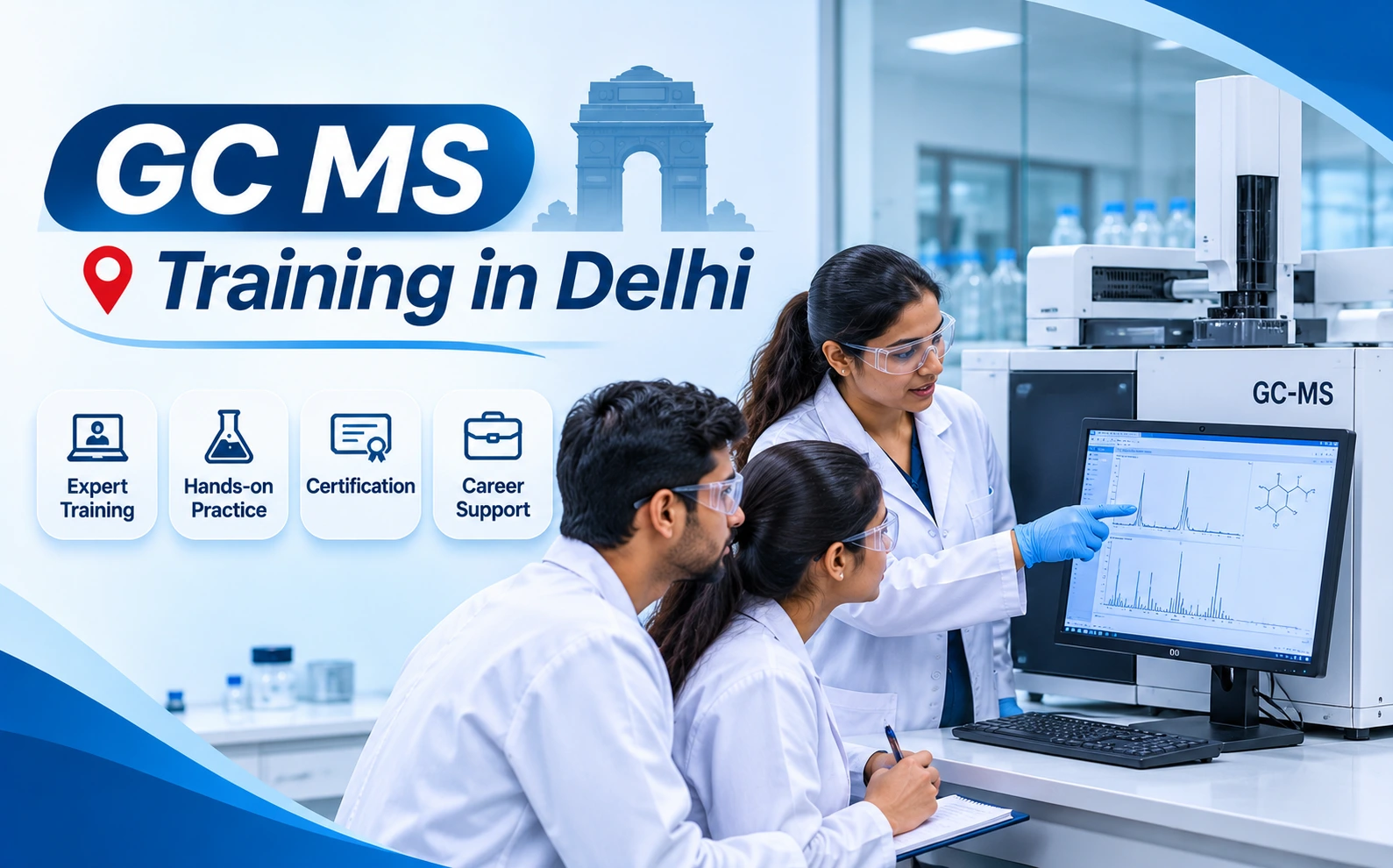
GC-MS Training: Working Principle, Applications & Practical Learning
GC-MS (Gas Chromatography-Mass Spectrometry) is an important analytical technique used in pharmaceutical, chemical and research laboratories. It helps analysts separate, identify and analyse different compounds present in a sample.
For students and professionals planning to build a career in pharmaceutical quality control (QC), analytical research or laboratory testing, understanding GC-MS is a valuable technical skill. However, theoretical knowledge alone is not enough. Learning instrument components, sample preparation, operating procedures and result interpretation is equally important.
Practical GC-MS training helps learners understand how this analytical instrument works and how it is used in laboratory environments.
In this guide, we will cover the GC-MS working principle, important instrument components, practical applications and the skills learners should develop during training.
What Is GC-MS and Why Is It Used in Laboratories?
GC-MS stands for Gas Chromatography-Mass Spectrometry. It combines two analytical techniques:
-
Gas Chromatography (GC): Separates different compounds present in a sample.
-
Mass Spectrometry (MS): Helps identify separated compounds based on their mass-to-charge ratio (m/z).
GC-MS is used in pharmaceutical laboratories for applications such as residual solvent analysis and the investigation of suitable volatile compounds. It is also used in chemical testing, environmental analysis and research laboratories.
Understanding this technique is useful for students interested in analytical instrumentation and pharmaceutical QC careers.
How Does GC-MS Work? Understanding Its Working Principle
The GC-MS working principle involves two major processes: compound separation and compound identification.
1. Gas Chromatography Separation
A prepared sample is introduced through the injection port, where it is vaporised. A carrier gas transports the sample through a chromatographic column.
Different compounds interact differently with the stationary phase inside the column. This causes them to travel at different rates and separate from one another.
2. Mass Spectrometry Identification
After separation, the compounds enter the mass spectrometer. The molecules are ionised, commonly through electron ionisation (EI), and the resulting ions are separated according to their mass-to-charge ratio.
The detector records these ions and generates mass spectra, which help analysts investigate and identify compounds.
In simple terms, GC separates the compounds, while MS provides information that helps identify them.
What Are the Main Components of a GC-MS Instrument?
Understanding the main components is an essential part of GC-MS instrument training.
| Component | Function |
|---|---|
| Sample Injection Port | Introduces and vaporises the sample |
| Carrier Gas System | Carries the sample through the GC column |
| GC Column | Separates sample components |
| GC Oven | Controls column temperature |
| Ion Source | Converts molecules into ions |
| Mass Analyser | Separates ions according to m/z |
| Detector | Records the ions and produces signals |
| Data System | Displays chromatograms and mass spectra |
During practical learning, students should understand the function of each component and how the GC and MS sections work together.
For a better understanding of laboratory instrumentation, you can also explore our refurbished Perkin Elmer GC-MS system.
What Are the Applications of GC-MS Analysis in Pharmaceutical Laboratories?
GC-MS analysis is used for several analytical applications, particularly when volatile or semi-volatile compounds need to be investigated.
Some important applications include:
-
Residual Solvent Analysis: Used to investigate residual solvents in pharmaceutical products.
-
Impurity Investigation: Helps analyse suitable volatile impurities.
-
Quality Control: Supports analytical testing in pharmaceutical laboratories.
-
Research and Development: Helps researchers study chemical compositions and compounds.
-
Environmental Testing: Used to analyse selected organic pollutants in environmental samples.
Learning these applications helps students understand why GC-MS is used in professional analytical laboratories.
You can also learn more about the role of gas chromatography in pharmaceutical QC laboratories.
What Should You Learn About GC-MS Sample Preparation and Instrument Operation?
Sample preparation and instrument operation are important parts of GC-MS practical training.
Before starting an analysis, an analyst needs to understand the sample, target compounds, solvent compatibility and analytical method.
Important learning areas include:
-
Understanding sample requirements and preparation procedures
-
Selection of suitable solvents
-
Sample dilution and extraction concepts
-
Understanding sample injection
-
Learning the role of carrier gas and GC column
-
Understanding oven temperature conditions
-
Introduction to instrument operating parameters
-
Following laboratory safety and instrument handling procedures
The exact preparation and operating procedure depends on the sample, analytical method and instrument configuration.
How Do You Read a GC-MS Chromatogram and Mass Spectrum?
Learning how to read a GC-MS result is an important skill for analytical laboratory professionals.
Two important outputs are used during GC-MS data interpretation.
1. GC-MS Chromatogram
A chromatogram displays detector response against time. Important features include:
-
Retention time: Time taken by a compound to reach the detector.
-
Peaks: Signals representing detected compounds.
-
Peak area: Commonly used for quantitative analysis.
-
Peak height: Maximum intensity of a chromatographic peak.
2. Mass Spectrum
A mass spectrum displays ion intensity against mass-to-charge ratio (m/z).
Important terms include:
-
Molecular ion: May provide information about molecular mass.
-
Base peak: The most intense peak in the spectrum.
-
Fragment ions: Smaller ions formed during molecular fragmentation.
Analysts may compare mass spectra with reference libraries to support compound identification. Understanding these results is an important part of GC-MS data interpretation training.
What Is GC-MS Method Development and Why Is It Important?
GC-MS method development involves selecting suitable analytical conditions to achieve reliable separation and detection of target compounds.
Important parameters include:
-
GC column selection
-
Carrier gas selection and flow conditions
-
Injection conditions
-
Initial and final oven temperatures
-
Temperature programming
-
Ionisation conditions
-
Mass range and acquisition parameters
Method optimisation helps improve separation, peak shape, sensitivity and analysis time.
Students should understand how these parameters influence analytical results and why methods must be evaluated for their intended purpose.
What Practical Skills Can You Learn During GC-MS Training?
A structured GC-MS training course should help learners connect theoretical concepts with laboratory procedures.
Important learning areas may include:
-
Introduction to GC-MS instrumentation
-
Understanding the working principle
-
Identification of major instrument components
-
Sample preparation concepts
-
Understanding instrument operation
-
Introduction to analytical parameters
-
Chromatogram and mass spectrum interpretation
-
Basic data analysis
-
Introduction to method development
-
Common instrument issues and troubleshooting concepts
The actual hands-on activities depend on the instrument configuration and facilities available during the programme.
Practical exposure can help learners become more familiar with analytical laboratory workflows and develop a stronger technical foundation.
You can also explore how gas chromatography is used in R&D laboratories to understand its broader analytical applications.
Who Should Join GC-MS Training?
GC-MS training can be useful for students Who are and professionals from relevant pharmaceutical and science backgrounds.
B.Pharm Students and Graduates: Those interested in pharmaceutical QC, analytical testing and laboratory careers.
M.Pharm Students: Those interested in pharmaceutical analysis, research and quality control.
M.Sc. Chemistry Students: Those who want to understand analytical instrumentation and chemical analysis.
Freshers and Job Seekers: Candidates preparing for entry-level analytical laboratory positions.
Working QC Professionals: Analysts who want to strengthen their understanding of GC-MS instrumentation and analytical workflows.
Where Can You Get GC-MS Training in Delhi?
Students and professionals searching for GC-MS training in Delhi should look for programmes that explain instrument theory and provide relevant practical learning opportunities.
Before selecting a training institute, consider:
-
Coverage of GC-MS working principles and instrumentation
-
Practical exposure to the instrument
-
Sample preparation and operating procedures
-
Chromatogram and mass spectrum interpretation
-
Introduction to method development
-
Trainer experience and course structure
-
Clear details about duration, fees and certification
At Spectrachrome, we provide analytical instrument training for students and professionals interested in developing their laboratory instrumentation skills.
Our training programmes cover instruments including:
-
HPLC
-
LC-MS
-
GC-MS
-
Gas Chromatography (GC)
-
FTIR
-
UV Spectrophotometer
If you are looking for GC-MS practical training in Delhi, contact our team to understand the available programme, instrument coverage, practical learning opportunities, eligibility and course details.
Build your analytical instrumentation knowledge with Spectrachrome. Contact our team to enquire about upcoming training batches.
Frequently Asked Questions About GC-MS Training
1. What is GC-MS training?
GC-MS training introduces learners to Gas Chromatography-Mass Spectrometry, including its working principle, components, sample preparation, instrument operation and data interpretation.
2. Who can join GC-MS training?
B.Pharm, M.Pharm and M.Sc. Chemistry students, freshers and relevant laboratory professionals may find GC-MS training useful. Eligibility depends on the programme.
3. What is the difference between GC and GC-MS?
GC separates compounds in a sample, while GC-MS combines this separation with mass spectrometry to provide information that helps identify the compounds.
4. Is practical GC-MS training useful for freshers?
Yes. Practical learning can help freshers understand instrument components, laboratory workflows, sample preparation concepts and analytical result interpretation.
5. Where can I get GC-MS training in Delhi?
You can contact Spectrachrome to enquire about GC-MS training availability, course structure and practical learning opportunities in Delhi.
Conclusion
GC-MS is an important analytical technique used in pharmaceutical and research laboratories. Understanding its working principle, instrumentation, sample preparation, operation and data interpretation can help students and professionals develop relevant analytical skills.
If you are looking for GC-MS training in Delhi, explore the analytical instrument training programmes at Spectrachrome and contact our team for current course details.