LC-MS Training: Working Principle, Applications & Practical Guide
Nov 20, 2026
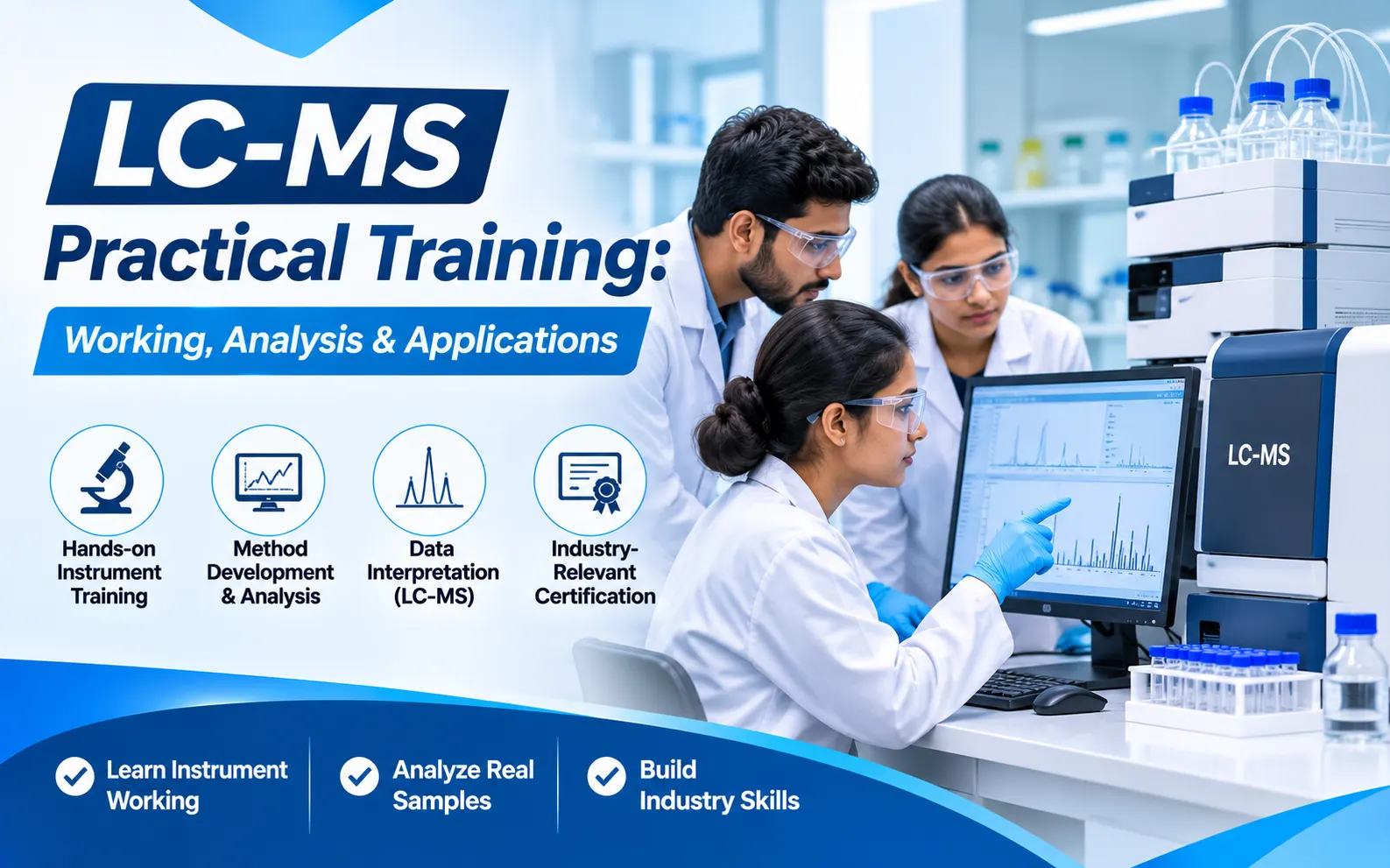
Introduction
Liquid Chromatography-Mass Spectrometry (LC-MS) is an important analytical technique used to separate, identify and quantify compounds in complex samples. It combines the separation capability of liquid chromatography with the identification and detection capabilities of mass spectrometry.
For students pursuing B.Pharm, M.Pharm and M.Sc., understanding LC-MS can help build knowledge of modern analytical techniques used in pharmaceutical research, quality control and laboratory analysis.
This guide explains the LC-MS working principle, instrument components, applications and the practical skills students should understand through LC-MS training.
What Is LC-MS and How Does It Work?
LC-MS (Liquid Chromatography-Mass Spectrometry) is an analytical technique that combines two processes:
- Liquid Chromatography (LC): Separates different compounds present in a sample.
- Mass Spectrometry (MS): Analyses the separated compounds based on their mass-to-charge ratio (m/z).
First, the sample passes through an LC column, where its components are separated. As these components leave the column, they enter the mass spectrometer, where they are ionised and analysed according to their mass-to-charge ratio.
This combination provides information that helps analysts identify and quantify compounds in complex samples.
What Is the Working Principle of LC-MS?
The LC-MS working principle involves sample separation, ionisation, mass analysis and detection. The process generally follows these steps:
- Sample Preparation: The sample is prepared using a suitable solvent and filtration or other appropriate preparation steps, depending on the analytical method.
- Sample Injection: The prepared sample is introduced into the liquid chromatography system.
- Chromatographic Separation: The LC column separates sample components based on their interactions with the mobile and stationary phases.
- Ionisation: The separated compounds enter the ion source, where they are converted into gas-phase ions. Electrospray ionisation (ESI) is a commonly used technique.
- Mass Analysis: The mass analyser separates ions according to their mass-to-charge ratio (m/z).
- Detection and Data Recording: The detector records ion signals, which are processed by the instrument software for interpretation.
Understanding these stages is an important part of learning LC-MS instrument operation.
What Are the Main Components of an LC-MS Instrument?
Knowing the major LCMS instrument components helps students understand how the system performs an analysis.
|
Component |
Function |
|---|---|
|
Pump |
Delivers the mobile phase at a controlled flow rate |
|
Autosampler |
Introduces samples into the LC system |
|
LC Column |
Separates compounds present in the sample |
|
Ion Source |
Converts eluted compounds into ions |
|
Mass Analyser |
Separates ions according to their m/z |
|
Detector |
Records the signals from the separated ions |
|
Software |
Displays and processes chromatographic and mass spectral data |
The exact configuration depends on the instrument model and analytical requirements.
How Is LC-MS Used in Pharmaceutical Analysis?
LC-MS analysis is used in pharmaceutical laboratories because it combines chromatographic separation with mass-based detection.
Some important applications include:
- Drug Analysis: Helps identify and quantify pharmaceutical compounds.
- Impurity Profiling: Supports the investigation and identification of impurities in drug substances and products.
- Metabolite Analysis: Helps study drug metabolites and their presence in biological samples.
- Bioanalytical Research: Used to analyse compounds in biological matrices such as plasma and serum.
- Research and Development: Supports analytical investigations during pharmaceutical research.
The suitability of LC-MS for a particular application depends on the sample, method, instrument configuration and validation requirements.
What Do Students Learn in Practical LC-MS Training?
LC-MS practical training should help students connect theoretical knowledge with the actual analytical workflow.
Important learning areas include:
- Understanding the basic layout and components of an LC-MS system.
- Learning the purpose of the LC and MS sections.
- Understanding sample preparation and injection procedures.
- Learning about ionisation techniques such as ESI.
- Understanding mass-to-charge ratio (m/z).
- Observing chromatograms and mass spectra.
- Understanding basic data interpretation.
- Learning about instrument care, contamination prevention and routine precautions.
Practical exposure helps students understand how different instrument components work together during an analysis. The exact practical activities depend on the instrument model and training module.
Who Should Join LC-MS Training?
LC-MS training for pharmacy students can be useful for students and professionals who want to develop their understanding of advanced analytical instrumentation.
The programme is relevant for:
- B.Pharm Students: Interested in pharmaceutical analysis and analytical laboratory techniques.
- M.Pharm Students: Looking to strengthen their knowledge of analytical methods used in pharmaceutical research and quality control.
- M.Sc. Students: From relevant chemistry and life-science backgrounds who want to understand mass spectrometry applications.
- Freshers: Interested in developing analytical instrumentation knowledge before entering laboratory roles.
- QC Experienced Professionals: Looking to improve their understanding of advanced analytical techniques.
What Skills Can Students Gain from an LC-MS Course?
A structured LCMS course can help learners develop foundational knowledge and practical understanding of:
- LC-MS instrument components and their functions.
- Basic analytical workflow and sample handling.
- Chromatographic separation and mass spectral concepts.
- Understanding retention time and mass-to-charge ratio.
- Basic interpretation of chromatograms and mass spectra.
- Awareness of laboratory practices and instrument maintenance.
These skills can support further learning in pharmaceutical analysis, analytical research and quality control laboratories. Training alone does not guarantee employment or professional competency; practical experience and continued learning are also important.
Learning HPLC step by step is a useful starting point before moving to LC-MS, because the liquid chromatography part of the system follows the same principles.
How Can You Enquire About LC-MS Training in Delhi?
Students looking for LC-MS training in Delhi should consider programmes that explain the instrument's working principle and provide relevant practical exposure.
Before enrolling, check:
- Whether the programme includes practical instrument exposure.
- Which LC-MS model or configuration is covered.
- Whether sample preparation and data interpretation are included.
- Who will provide the technical training.
- What the programme duration and certificate details are.
Spectrachrome offers analytical instrument training for students and laboratory professionals. If you are pursuing B.Pharm, M.Pharm or M.Sc. and want to understand LC-MS and other analytical instruments, you can contact the team to enquire about the available training schedule, practical coverage and eligibility.
Interested in analytical instrument training? Contact Spectrachrome to enquire about the programme.
Frequently Asked Questions
1. What does LC-MS stand for?
LC-MS stands for Liquid Chromatography-Mass Spectrometry. It combines liquid chromatography and mass spectrometry to separate, identify and quantify compounds.
2. What is the difference between LC-MS and HPLC?
HPLC separates compounds using a liquid mobile phase and a chromatographic column. LC-MS combines liquid chromatography with mass spectrometry, adding mass-based information about the separated compounds.
3. Is LC-MS training useful for B.Pharm and M.Pharm students?
Yes. It can help pharmacy students understand advanced analytical instrumentation and its applications in pharmaceutical analysis and research.
4. What is m/z in mass spectrometry?
The term m/z represents the mass-to-charge ratio of an ion. A mass analyser uses this value to separate ions during analysis.
5. What is the duration of LC-MS training?
The duration depends on the training programme and its practical coverage. Students should confirm the schedule and instrument-specific training details with the training provider before enrolling.
Conclusion
LC-MS is an important analytical technique for the identification and quantification of compounds in pharmaceutical and research laboratories. Understanding its working principle, components, sample workflow and data interpretation can help students build a stronger foundation in analytical instrumentation.
For B.Pharm, M.Pharm and M.Sc. students interested in developing these skills, LC-MS training can be a useful step towards understanding modern laboratory techniques.