How to Learn HPLC: Roadmap, Syllabus and What a Good HPLC Course Should Cover
Nov 15, 2026
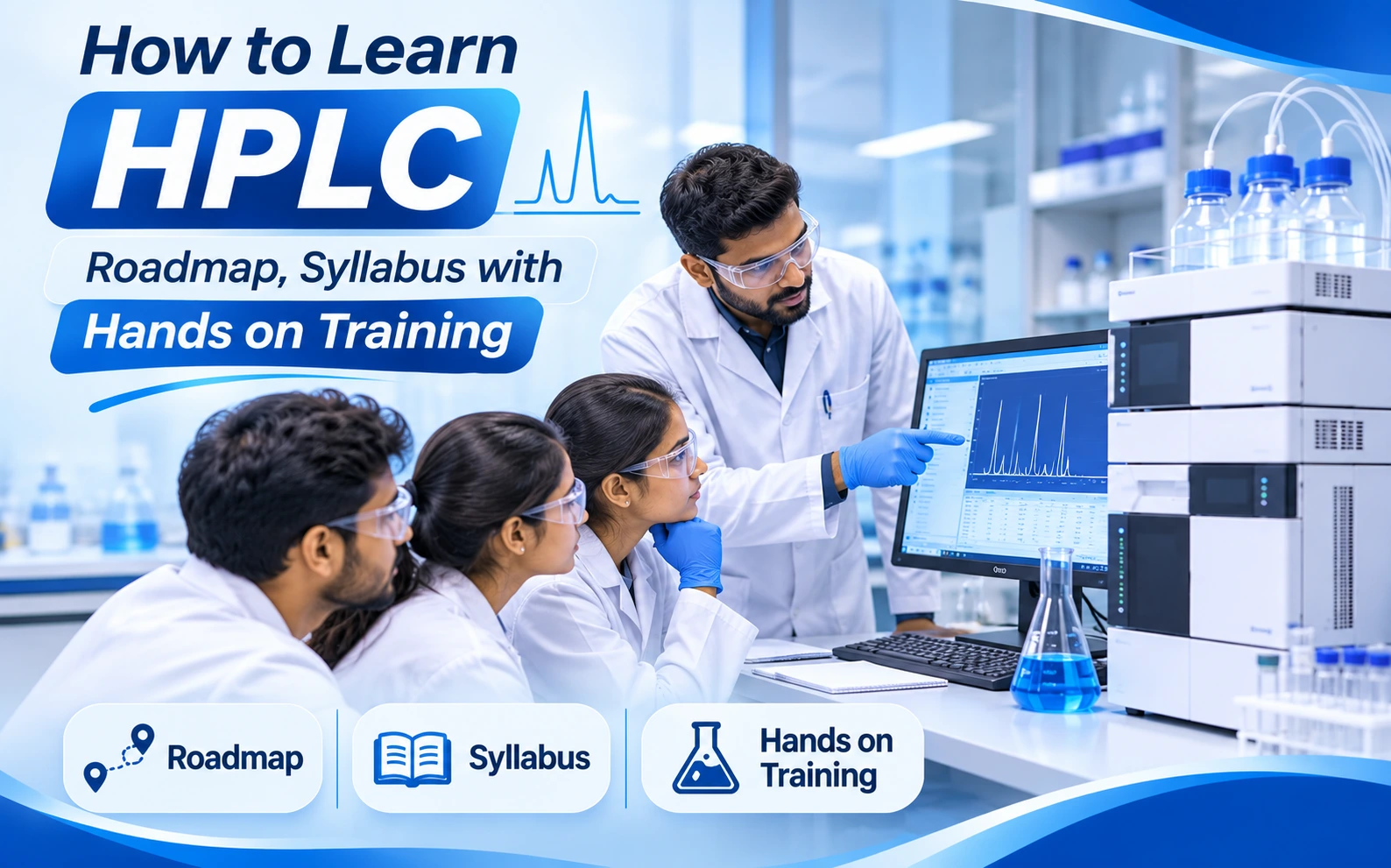
High performance liquid chromatography is one of the most widely used techniques in pharmaceutical, food and environmental labs, and most QC and analytical roles expect you to be comfortable with it. The good news is that you do not need years of experience to start. You need a clear order in which to learn things, and enough hands-on time with a real instrument.
This guide explains how to learn HPLC from the basics to method validation, what a good syllabus looks like, how long it usually takes, and what to look for when you compare training options. Technical details come from manufacturer learning resources and regulatory guidelines, and the sources are listed at the end.
Quick answer: what is the best way to learn HPLC?
Start with the principle of separation, then learn the parts of the instrument, then practise running real samples, and finally move on to data handling, method development, validation and troubleshooting. Theory can be learned from books or online, but running an instrument yourself is what turns knowledge into skill.
|
Step |
What to learn |
Why it matters |
|---|---|---|
|
1 |
Separation principle and basic terms |
Explains why compounds separate |
|
2 |
Instrument modules |
Helps you understand what each part controls |
|
3 |
Mobile phases and columns |
Decide how well a method works |
|
4 |
Hands-on operation |
Builds practical confidence |
|
5 |
Data and calculations |
Turns peaks into reportable results |
|
6 |
Method development and validation |
Required in regulated labs |
|
7 |
Troubleshooting and maintenance |
Keeps the system reliable |
What is HPLC and why do labs need trained analysts?
HPLC separates the compounds in a liquid sample and measures each one. A pump pushes a liquid mobile phase through a column packed with fine particles, the sample is injected into that flow, and a detector records each compound as it leaves the column. Labs use it to measure the strength of a medicine, find impurities, check food additives or test water for pollutants.
Because the results often decide whether a batch is released, labs need analysts who can run the instrument correctly, spot problems early and document everything properly. That is why HPLC learning is a core skill for QC and analytical roles.
Who can learn HPLC?
Anyone with a basic science background can learn it. Most learners are B.Pharm, M.Pharm and M.Sc graduates, along with QC analysts who want to move from routine work into method development or troubleshooting. You do not need prior instrument experience to start, but a comfortable grasp of basic chemistry makes every later step easier.
What should I know before I start learning HPLC?
A few fundamentals will save you time:
- Solutions and concentration: molarity, dilutions, percentages and units such as mg/mL and µg/mL.
- Acids, bases and pH: buffers are used in many mobile phases.
- Polarity: it decides which compounds stick to the column and which pass through quickly.
- Basic laboratory practice: weighing, volumetric glassware and safe handling of solvents.
- Spreadsheet skills: calibration curves and percentage calculations are part of daily work.
If any of these feel rusty, revise them first. They appear in almost every HPLC method.
How do I learn HPLC step by step?
Step 1: Understand the principle of separation
Compounds separate because they interact differently with the stationary phase and the mobile phase. According to Shimadzu, the more strongly a compound interacts with the stationary phase, the more slowly it moves through the column. Reversed-phase is the most common mode, with a non-polar stationary phase such as C18 and a polar mobile phase, so polar compounds usually elute first. Spend time on this idea, because every other topic builds on it.
Step 2: Learn the parts of the instrument
An HPLC system has a pump, an injector or autosampler, a column, a detector and a data system, and most also include a solvent reservoir, degasser and column oven. Knowing what each module controls helps you read a method and diagnose problems. You can see how these modules are arranged in real instruments by browsing refurbished HPLC systems.
Step 3: Learn mobile phases and columns
Learn how to prepare buffers and organic solvents, why the mobile phase should be filtered and degassed, and how column choice affects the separation. According to JASCO, the industry-standard column for conventional HPLC is 100 to 150 mm long with 3 to 5 µm particles and a 4.6 mm internal diameter, so start by understanding that format before moving to others.
Step 4: Practise running the instrument
This is the step that cannot be skipped. A typical startup routine, as described by JASCO, is to prepare and degas the mobile phase, prime the pump, check the flow path for leaks, install and equilibrate the column until pressure and baseline are stable, warm up the detector, and then run a blank before samples. Doing this yourself, repeatedly, teaches you what a normal baseline and pressure look like.
Step 5: Learn to read chromatograms and do the calculations
The time at which a peak appears (retention time) helps identify a compound, and the peak area is used to calculate how much is present, usually against a calibration curve. You should also learn system suitability, which checks that the instrument and method are performing properly before you analyse samples. Pharmacopoeial chromatography chapters, such as USP <621>, describe the common parameters.
Step 6: Learn method development and validation
Once you can run a method, learn how methods are built and proven. Method validation shows that a procedure is suitable for its purpose. The ICH Q2(R2) guideline, described by the European Medicines Agency, covers validation of analytical procedures used for release and stability testing of drug substances and products, and its parameters include accuracy, precision, specificity, detection limit, quantitation limit, linearity and range.
Step 7: Learn troubleshooting and maintenance
Experienced analysts are valued for how quickly they find the cause of a problem. Learn the common ones: pressure that is too high or fluctuating, baseline noise and drift, air bubbles in the pump, peak tailing and shifting retention times. Learn routine maintenance too, such as seal and check valve care and column cleaning.
Step 8: Learn documentation and data integrity
In regulated labs, a result is only as good as its records. Chromatography data systems manage electronic records and audit trails, and JASCO notes they support requirements such as 21 CFR Part 11. Learning good documentation practice early makes you far more employable.
What should an HPLC course syllabus include?
A complete HPLC chromatography course should combine theory with practical work. The table below shows the topics to look for.
|
Module |
Topics to expect |
Why it matters |
|---|---|---|
|
Fundamentals |
Principle, retention, reversed-phase and normal-phase, terms such as resolution and tailing |
Foundation for everything else |
|
Instrumentation |
Pump, injector, column, oven, detectors, data system |
Lets you understand and operate the system |
|
Mobile phase and columns |
Buffer preparation, solvent grades, column selection and care |
Controls separation quality |
|
Hands-on operation |
Startup, priming, equilibration, injections, shutdown |
Builds practical skill |
|
Data and calculations |
Integration, calibration, assay and impurity calculations, system suitability |
Produces reportable results |
|
Method development |
Choosing column, mobile phase, gradient and detector |
Needed for R&D and method transfer |
|
Method validation |
Accuracy, precision, specificity, linearity, range, LOD, LOQ |
Required in regulated labs |
|
Troubleshooting and maintenance |
Pressure, baseline, peak shape, leaks, routine care |
Reduces downtime |
|
Quality and compliance |
GLP, documentation, data integrity, lab accreditation basics |
Needed for audits |
Depending on your industry, you may also want modules on food and pesticide residue analysis or on ISO/IEC 17025, the standard for testing and calibration laboratories.
How do I choose a good HPLC course?
A chromatography course can look impressive on paper and still leave you unable to run an instrument. Use these questions to compare options:
- How many hours are hands-on? Look for real time on an instrument, not only demonstrations.
- How many people share each instrument? Small batches mean more practice for each person.
- Which instruments and detectors are used? Ideally they match what labs actually run.
- Who teaches? Trainers with industry or QC experience can explain why, not only how.
- Does it cover method validation and troubleshooting? These skills separate trained analysts from beginners.
- What do you receive at the end? A study kit and a certificate are useful, but ask what the certificate represents. A completion certificate shows you attended and finished the program. It is not the same as an accredited qualification, so check how a program describes it.
Can I learn HPLC online, or do I need hands-on training?
You can learn the theory through online HPLC training, books and manufacturer learning pages, and doing so is a good way to prepare. However, HPLC is a practical skill. Priming a pump, handling a column, spotting a leak and recognising a stable baseline are things you learn by doing. If your goal is a lab job, choose a program with real instrument time, or combine online theory with hands-on practice.
How long does it take to learn HPLC?
It depends on your starting point and how much practice you get. The basics of the principle and instrument can be covered in a focused short course, while real confidence with method development, validation and troubleshooting comes with repeated practice on different samples. For example, Spectrachrome's training program runs for 5 days, with 3 days of theory and 2 days of hands-on practice, and is designed to give a structured start rather than complete experience.
What jobs and skills does HPLC training lead to?
HPLC skills are used in roles such as QC analyst, analytical R&D, stability testing, method validation and food or environmental testing. In pharma, for instance, analysts run assay, impurity and stability studies, which is why our article on HPLC in pharmaceutical stability testing is a useful next read. Training builds the skills employers look for, but employers also value experience, so keep practising after the course.
Which other instruments should I learn along with HPLC?
Many labs run several techniques, so learning a second one makes you more flexible. Gas chromatography suits volatile compounds, while UV-Vis spectrophotometry and FTIR are common for simpler assays and identification.
GC-MS and LC-MS add mass spectrometry for identification. To see how LC-MS technology has developed, read our article on the evolution of LC-MS.
Within liquid chromatography, UHPLC or UPLC is a natural next step once you are comfortable with conventional HPLC, and our guide to HPLC vs UPLC explains the differences.
What does Spectrachrome's HPLC training include?
Spectrachrome runs a commercial lab training program in Delhi for pharma, food and research. It is designed for B.Pharm, M.Pharm and M.Sc freshers and for QC professionals. The program runs for 5 days, with 3 days of theory and 2 days of hands-on practice, and covers instruments including HPLC, LC-MS, GC-MS, GC, FTIR and UV spectrophotometers. Special modules include method validation as per SANTE guidelines and training on ISO 17025. Participants receive study materials and a certificate of completion.
If you would like current batch dates and fees, contact our team.
Frequently asked questions
Can a fresher learn HPLC without any experience?
Yes. A science graduate can start from the principle, learn the instrument parts and then practise on a real system. A structured program with hands-on time makes this faster.
Is HPLC difficult to learn?
The basic idea is simple, but getting reliable results takes practice. Method development and troubleshooting are the harder parts and improve with experience.
Do I need to know chemistry before learning HPLC?
Basic chemistry helps, especially solutions, pH, buffers and polarity. You do not need advanced organic chemistry to begin.
What is the difference between theory and practical training in HPLC?
Theory explains principles, calculations and regulations, while practical training teaches you to prepare mobile phases, run the system, process data and solve problems.
Is HPLC training enough to get a job?
It gives you the skills employers look for, but hiring also depends on your qualifications, practice and how well you can demonstrate what you learned.
Conclusion
The quickest way to learn HPLC is to follow a clear order: principle, instrument, mobile phase and column, hands-on operation, data handling, validation and troubleshooting. Theory can be learned anywhere, but hands-on time on a real instrument is what makes the learning stick. When you compare courses, look for real practical hours, small batches, coverage of validation and troubleshooting, and clarity about what the certificate represents.
If you want structured, hands-on training in Delhi, get in touch and we will share the current schedule.
Related Posts
HPLC Training and Certification: Course Types, What You Get and How to Choose a Program
What HPLC certification means, the types of HPLC training, what a good course covers and how to choose a program in Delhi.
HPLC Instrumentation: Components, Diagram and Working Principle
High performance liquid chromatography separates a mixture into its individual compounds and measures each one. To do that, an HPLC system relies on a...