UV Spectrophotometer Training: Working Principle, Instrumentation & Practical Guide
Nov 22, 2026
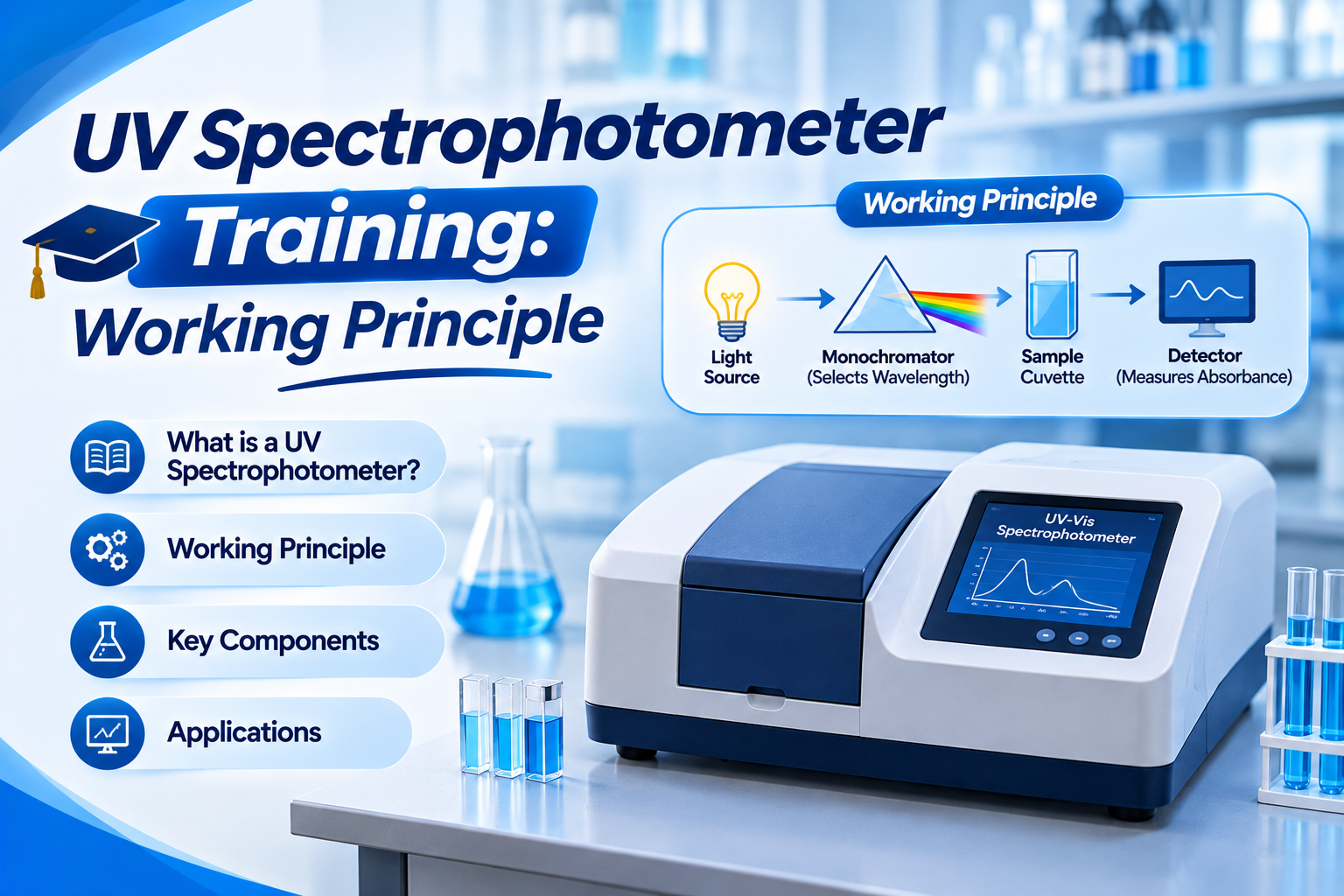
A UV spectrophotometer is one of the most common instruments in pharmaceutical, food and research laboratories. It looks simple to operate, but reliable results need more than pressing a button. The wrong cuvette, a dirty optical surface, a poorly chosen blank or a badly prepared sample can quietly spoil a result.
This guide explains the working principle, the main parts, a block diagram and a step-by-step method for using the instrument. It then explains why UV spectrophotometer training matters for B.Pharm, M.Pharm and M.Sc. students, freshers and working lab staff, and how to enquire about training in Delhi NCR.
What Is a UV Spectrophotometer?
A UV spectrophotometer, also called a UV-Vis spectrophotometer, measures how much ultraviolet and visible light a sample absorbs at different wavelengths. The ultraviolet region is roughly 190 to 400 nm and the visible region roughly 400 to 800 nm. Samples are usually liquids, so solids are first dissolved in a suitable solvent.
Analysts use it in two ways. Qualitatively, the wavelength of maximum absorbance (λmax) and the shape of the spectrum help identify a substance. Quantitatively, the absorbance at a chosen wavelength is used to calculate concentration.
UV-visible spectrophotometer models differ in wavelength range, beam type, spectral bandwidth and software, which is why knowing the basics helps you operate any of them with confidence.
Working Principle of UV Spectrophotometer
The working principle of UV spectrophotometer instruments is light absorption. Molecules absorb light of specific wavelengths because the energy moves electrons to a higher level. The instrument sends a selected wavelength through the sample, compares the light entering (I₀) with the light leaving (I), and reports the result as absorbance.
- Transmittance (T) = I / I₀
- Absorbance (A) = log₁₀ (I₀ / I)
Absorbance is linked to concentration by the Beer-Lambert law:
A = ε × c × l
- A is absorbance, which has no unit.
- ε is the molar absorptivity of the substance at that wavelength.
- c is the concentration of the solution.
- l is the path length of the cuvette, usually 1 cm.
Because absorbance rises in proportion to concentration, an analyst can prepare standards of known strength, plot a calibration curve and read the concentration of an unknown sample from it. Results are most reliable when absorbance falls within the instrument's linear range, commonly cited as about 0.1 to 1.0.
Instrumentation of UV Spectrophotometer – Main Parts and Components
The instrumentation of UV spectrophotometer systems follows a simple chain: source, wavelength selector, sample holder, detector and readout. Knowing these spectrophotometer parts helps you understand what can go wrong and why.
|
Component |
Function |
Common types |
|---|---|---|
|
Light source |
Produces continuous UV and visible light |
Deuterium lamp (UV), tungsten or tungsten-halogen lamp (visible) |
|
Monochromator |
Selects one wavelength at a time |
Diffraction grating with entrance and exit slits |
|
Sample holder |
Holds the cuvette in the light path |
Single cell holder or multi-cell changer |
|
Detector |
Converts light into an electrical signal |
Photodiode, photomultiplier tube, diode array |
|
Readout and software |
Calculates absorbance, spectra and concentration |
Onboard display or PC software |
Light source
No single lamp covers the whole range, so most instruments use two. The deuterium lamp provides continuous ultraviolet light, and the tungsten or halogen lamp provides visible light. The instrument switches between them automatically at a changeover wavelength that depends on the model.
Monochromator
The source emits a broad band of light, but Beer's law applies to a narrow band. The monochromator uses a diffraction grating to split the light and passes only the wavelength you select to the sample.
Cuvette and sample holder
Cuvette material decides which wavelengths you can measure. Quartz cuvettes transmit UV light and are used for UV work. Glass absorbs UV, and most plastic cuvettes do too, so they suit visible-range measurements only.
Detector
The detector measures the light that passes through the sample. Photodiodes are common, photomultiplier tubes are very sensitive, and diode arrays can capture a full spectrum at once.
Readout and software
Software converts the signal into absorbance, spectra and concentration, and controls scans, kinetics and reports. In regulated labs, it should also support user access control and audit trails.
UV Spectrophotometer Diagram and Working Process
A basic spectrophotometer diagram shows the light path in order: source, monochromator, cuvette, detector and readout.
[Insert image here: uv-spectrophotometer-diagram.png. Alt text: UV spectrophotometer diagram showing light source, monochromator, cuvette and detector]
The working process in six steps:
- The lamp produces light across the UV and visible range.
- The monochromator selects one wavelength.
- That light passes through the cuvette containing the sample.
- The sample absorbs part of the light.
- The detector measures the light that comes through.
- The software compares it with the blank and reports absorbance.
How to Use a UV Spectrophotometer – Step-by-Step Guide
The exact steps depend on the model and your lab's SOP, but how to use a UV spectrophotometer follows the same logic everywhere.
- Switch on and warm up. Switch on the instrument and allow the lamps to stabilize as per the manufacturer's instructions.
- Choose the right cuvette. Use quartz for UV measurements. Check that it is clean, unscratched and matched to its pair.
- Set the method. Select the wavelength or scan range and the measurement mode in the software.
- Prepare the blank. Fill a cuvette with the same solvent or reagent mix as your sample, without the analyte.
- Zero the instrument. Place the blank in the holder and run the baseline or auto-zero.
- Prepare and load standards and samples. Handle cuvettes by the frosted sides, fill to the marked level, wipe the clear faces and remove air bubbles.
- Measure. Read the standards from low to high concentration, then the samples, rinsing the cuvette between solutions.
- Calculate. Plot the calibration curve and read the sample concentration, checking that sample absorbance falls within the linear range.
- Clean up. Rinse the cuvettes, switch off the lamps and record the work in the logbook.
Reading these steps is easy. Doing them consistently on a real instrument is what builds skill. Enquire about hands-on UV spectrophotometer training to practise these steps with guidance.
Applications of UV Spectrophotometer in Pharmaceutical Laboratories
The UV spectrophotometer uses in pharmaceutical QC and analytical labs include:
- Assay: Measuring the strength of a drug in a tablet, capsule or solution.
- Dissolution testing: Measuring how much drug has dissolved in a medium over time.
- Content uniformity: Checking that each dosage unit contains the expected amount.
- Identification: Comparing λmax and spectra with a reference.
- Raw material checks: Verifying the quality of incoming materials.
The same instrument is used in food testing for colour and additives, in water testing for nutrients and residual chlorine, and in research for nucleic acids and reaction kinetics. Spectrophotometers used for regulated work also need regular performance checks, such as wavelength accuracy and photometric accuracy, as defined in your quality system.
Single Beam vs Double Beam Spectrophotometer
Among the types of spectrophotometer used in labs, the most common choice is between single beam and double beam. The difference between single beam and double beam spectrophotometer designs is in how the light is handled. In a single beam instrument, all the light passes through the sample cell, so the blank and the sample are measured one after the other. In a double beam instrument, the light is split into two beams, one through the sample and one through a reference, and the readings are compared.
|
Feature |
Single beam |
Double beam |
|---|---|---|
|
How it works |
Measures blank first, then sample |
Splits light into sample and reference paths |
|
Stability |
Lamp drift can affect results between readings |
Compensates for lamp variation during measurement |
|
Typical use |
Routine fixed-wavelength work, teaching, simple QC |
Spectral scans, long-term stability, regulated work |
|
Cost |
Lower |
Higher |
Spectrachrome lists a refurbished Shimadzu UV-1601, a double-beam instrument with a 190 to 1100 nm range. Choose single beam for routine, cost-sensitive measurements, and double beam when you need spectral scanning or higher stability.
Common Mistakes While Operating a UV Spectrophotometer
Most errors come from handling, not from the instrument. Watch for these:
- Using glass or plastic cuvettes for UV measurements.
- Touching the clear faces of the cuvette or leaving fingerprints and smudges.
- Leaving air bubbles in the cuvette.
- Using a blank that does not match the sample solvent.
- Skipping the warm-up period.
- Measuring samples with absorbance far outside the linear range instead of diluting them.
- Using a solvent that absorbs at the measurement wavelength.
- Measuring cloudy samples with particles, which scatter light.
- Forgetting to re-zero after changing the solvent or wavelength.
Why Is UV Spectrophotometer Training Important?
Reading about an instrument and operating one are different skills. UV spectrophotometer operation training gives you time on a real instrument, where you learn what a normal baseline looks like, how a poorly filled cuvette affects a reading and when a result should be repeated.
A good UV spectroscopy training course also builds habits that labs value: correct sample handling, honest documentation, awareness of performance checks and the ability to notice when something is wrong. These matter in interviews and in daily QC work, even though training alone does not guarantee a job.
Who Should Join UV Spectrophotometer Training?
UV-Vis practical training is useful for:
- B.Pharm, M.Pharm and M.Sc. students who want practical exposure beyond the syllabus.
- Freshers preparing for QC and analytical lab roles.
- Working QC staff who want to refresh their skills or learn a second instrument.
- Researchers who use UV-Vis occasionally and want to improve consistency.
UV Spectrophotometer Training in Delhi NCR
Spectrachrome's lab instrument training is a 5-day program at its Delhi training centre. It runs 3 days of theory followed by 2 days of hands-on practice, and covers HPLC, LC-MS, GC-MS, GC, FTIR and UV spectrophotometer. It is designed for B.Pharm, M.Pharm and M.Sc. students, freshers and QC staff, and participants receive study material and a certificate after completion.
Before you enrol in any UV spectrophotometer training in Delhi NCR, confirm these points with the provider:
- Batch dates, available instruments and seats.
- How much time you will spend operating the instrument yourself.
- Which UV spectrophotometer model is used and what the UV session covers.
- What the certificate states.
- The final fee, including GST.
Frequently Asked Questions (FAQs)
What is UV spectrophotometer training?
It is instruction in how a UV spectrophotometer works and how to operate it correctly, combining theory with hands-on practice on a real instrument.
How does a UV spectrophotometer work?
It passes a selected wavelength of light through a sample and measures how much is absorbed. Absorbance is related to concentration by the Beer-Lambert law.
How do you operate a UV spectrophotometer?
Warm up the instrument, choose a suitable cuvette, prepare a blank and zero the instrument, measure standards and samples, then calculate concentration from a calibration curve.
What are the main components of a UV spectrophotometer?
A light source, a monochromator, a sample holder for the cuvette, a detector and readout software.
What is the difference between single beam and double beam?
A single beam instrument measures the blank and sample one after the other. A double beam instrument splits the light and measures both at the same time, which improves stability.
Who can learn UV spectrophotometer operation?
Anyone with basic science knowledge. It suits B.Pharm, M.Pharm and M.Sc. students, freshers and working lab staff.
Why is a UV spectrophotometer useful in pharmaceutical QC?
Many drugs absorb UV light, so absorbance gives a quick way to measure assay, dissolution and content uniformity.
Where can I enquire about UV spectrophotometer training in Delhi NCR?
You can enquire through Spectrachrome's training page or contact page to confirm current batches, instruments and fees.
Conclusion
A UV spectrophotometer is easy to switch on and easy to misuse. Knowing the working principle, the parts, the correct operating steps and the common mistakes helps you produce results you can trust, and practising on a real instrument is what makes that knowledge stick.
If you want guided, hands-on practice, contact Spectrachrome to ask about current UV spectrophotometer training options and batch dates.
Related Posts
LC-MS Training: Working Principle, Applications & Practical Guide
Introduction Liquid Chromatography-Mass Spectrometry (LC-MS) is an important analytical technique used to separate, identify and quantify compounds i...
GC-MS Training: Working Principle, Applications & Practical Learning
GC-MS Training: Working Principle, Applications & Practical Learning GC-MS (Gas Chromatography-Mass Spectrometry) is an important analytical tech...